
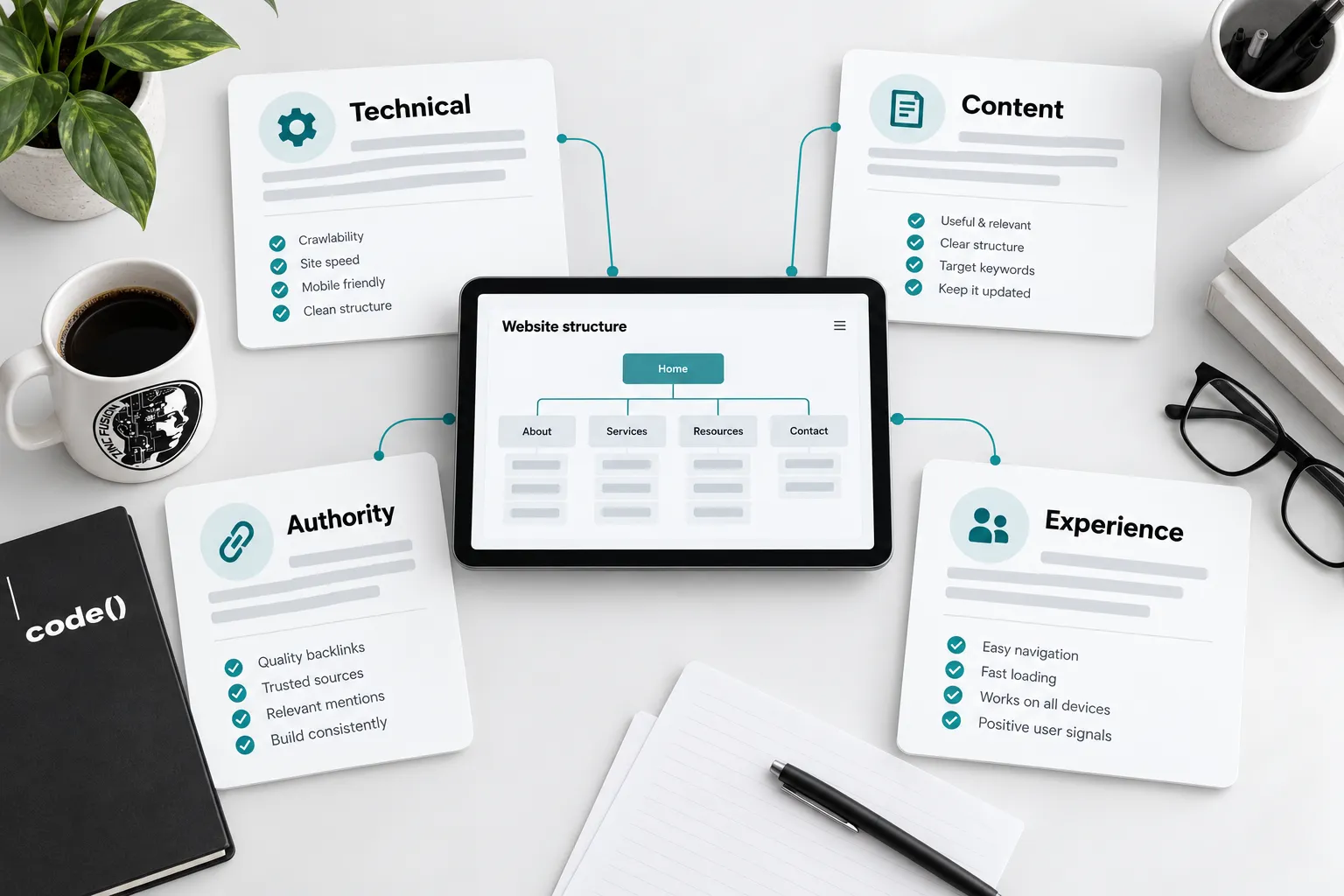
An SEO framework should help you decide what to fix next.
Technical SEO, content, authority, and UX are useful categories. Local SEO, analytics, and conversion work belong in the picture too. The diagram only earns its place if it helps you make a decision.
The operator question is simpler.
Can the site be crawled, understood, trusted, and improved over time?
If the answer is yes, the SEO program has a chance to compound. If the answer is no, the framework is mostly a presentation slide wearing business shoes.
For ZINC, the practical four-pillar model is:
- Technical foundation.
- On-page content and page quality.
- Authority and trust.
- Strategy, measurement, and compounding.
The names are not sacred. The relationship between them is.
What The Four Pillars Have To Prove
The four pillars are not four departments. They are four control layers.
Pillar · What It Proves · What Breaks When It Is Weak
Technical foundation · Search engines can crawl, render, index, and understand the site. · Good content stays invisible, duplicated, slow, blocked, or misinterpreted.
On-page content · Each page satisfies a real search job better than the alternatives. · Pages rank for the wrong intent, thin summaries compete badly, and visitors leave.
Authority and trust · The site, author, brand, and page have enough external and internal credibility to deserve visibility. · Better-known competitors win even when your page is technically cleaner.
Strategy and measurement · The work compounds toward business outcomes instead of random activity. · Teams publish, tweak, and report without building a durable search asset.
An SEO program does not fail because one title tag is weak. It fails because the system does not connect.
Technical work without content creates an empty but crawlable site. Content without technical access creates a library Google may not understand. Authority without page quality sends attention to weak pages. Strategy without measurement becomes calendar theater.
The pillars work when they reinforce each other.
The Four Pillars Are A Control System
Most operators do not need another SEO vocabulary lesson. They need a way to tell whether the work is complete enough to trust.
Use the pillars as an operating control system:
- Technical SEO answers: can search systems access and interpret the site?
- On-page SEO answers: does each page deserve to satisfy a specific query?
- Authority answers: why should this brand be trusted over a competitor?
- Strategy answers: how does the work compound into leads, sales, pipeline, or category visibility?
That is the useful lens.
If an SEO report only talks about keywords, it is missing the system. If it only talks about site speed, it is missing demand. If it only talks about backlinks, it is missing whether the pages are worth linking to. If it only talks about content volume, it is probably about to create a mess you will pay someone else to clean up later.
SEO is not one trick. It is a set of dependencies.
What AI Search Changes About SEO Fundamentals
AI search does not delete the pillars. It makes weak pillars easier to expose.
Google’s guidance for AI features still points back to the same fundamentals: make content crawlable, indexable, useful, visible on the page, and eligible for normal search systems. There is no magic AI-only switch that makes a vague website become a trusted source.
What changes is the way search systems may use the information.
A traditional search result might show a title, URL, and snippet. An AI-assisted result may summarize a topic, compare options, cite sources, pull entity facts, or help the user refine a decision. That means the site has to be clear at more than the page level. The guide to AI search results and generative search optimization explains those retrieval and citation surfaces.
Search systems need to understand:
- who published the content;
- who wrote or reviewed it;
- what the page is about;
- which service, product, location, or problem it supports;
- whether the visible text matches the structured data;
- whether internal links connect the topic to related pages;
- whether the brand has enough supporting evidence to trust.
That is still SEO. It is just less forgiving of vague content and disconnected site architecture.
The answer is not to write for robots. The answer is to make the business facts so clear that people and systems do not have to guess.
Pillar 1: Technical Foundation
Technical SEO is the access layer. Start with the technical SEO fixes that remove common access problems.
Before a page can rank, search engines need to crawl it, render it, choose a canonical version, understand the content, and decide whether it belongs in the index. That sounds basic because it is. Basic does not mean optional. If several URLs compete to represent the page, review duplicate content and canonical decisions before changing the copy.
Technical SEO includes:
- crawlability;
- indexation;
- mobile rendering;
- site speed and Core Web Vitals;
- internal link architecture;
- XML sitemaps;
- robots rules;
- redirects;
- canonical tags;
- duplicate URL handling;
- schema output;
- JavaScript rendering risk;
- image and media performance;
- template consistency.
The common mistake is treating technical SEO as a one-time checklist.
It is not.
Websites change. Developers ship templates. Plugins update. Shopify apps inject scripts. WordPress themes add markup. Landing pages get cloned. Redirects pile up. A clean technical foundation can decay quietly while everyone is arguing about content calendars.
For operators, the technical pillar should answer a few hard questions:
- Are the important pages crawlable and indexable?
- Are the right URLs canonical?
- Are redirects clean and intentional?
- Is the mobile version the version we actually want search systems to judge?
- Does the page render the content a visitor and crawler need?
- Does the structured data match visible content?
- Is the site fast enough that page experience is not creating friction?
The technical layer does not win by itself. It removes preventable limits.
Pillar 2: On-Page Content And Page Quality
On-page SEO is where intent becomes a page.
The page has to answer a real search job. Not a keyword. A search job.
Someone searching “how long does SEO take” is not only asking for a number. They are asking about expectations, budget risk, trust, sequencing, and how to tell whether the work is moving. Someone searching “technical SEO audit” is not only looking for a definition. They want to know what gets checked, what breaks, what matters first, and whether they can trust the person doing it. The SEO timeline guide breaks down those dependencies and waiting periods.
Good on-page work connects:
- the title tag;
- the H1 owned by the template;
- headings;
- visible body copy;
- examples;
- internal links;
- images and alt text;
- source citations;
- schema;
- CTA behavior;
- author/publisher context.
Thin content fails because it makes the reader keep searching.
Overwritten content fails because it buries the answer under SEO fog.
The useful middle is a page that gives enough context for the reader to make a decision and enough structure for search systems to classify it correctly.
For model ZINC posts, that usually means examples, source links, a practical framework, a clear operator takeaway, and a CTA that fits the reader’s stage. For a service page, it means offer clarity, proof, process, fit, and next action. For a product or ecommerce page, it means product facts, buyer questions, structured data, and conversion support.
The page is not optimized because a plugin score turned green. It is optimized when the page does the job.
Pillar 3: Authority And Trust
Authority is the trust layer.
It includes backlinks, brand mentions, author credibility, citations, reviews, business data consistency, local prominence, and whether other credible sources give search systems a reason to believe the site matters.
This is where a lot of SEO programs get sloppy.
They chase links without asking whether the links make sense. They publish guest posts nobody should read. They buy directory placements with all the subtlety of a billboard in a courtroom. Then they act surprised when the work does not age well.
Authority that lasts usually comes from useful assets:
- original research;
- credible guides;
- real case studies;
- source-worthy explanations;
- local prominence;
- partnerships;
- media mentions;
- community visibility;
- expert authorship;
- product or service quality that people actually reference.
For local businesses, authority also includes the local layer: Google Business Profile strength, citations, NAP consistency, local links, reviews, service area clarity, and proximity/context signals. For ecommerce, authority includes brand trust, product data consistency, merchant reputation, review integrity, and source-worthy category or buying content. The local SEO operating guide turns that local layer into a practical routine.
Authority is not a shortcut around page quality. It is what helps quality get believed.
Pillar 4: Strategy, Measurement, And Compounding
The fourth pillar is where SEO becomes a program instead of a pile of tasks.
Strategy decides what to build, what to fix, what to ignore, and how the pieces should compound. The SEO in 2026 guide separates current priorities from claims that do not justify more work.
Measurement decides whether the work is producing business value. Use the Search Console decision guide to turn query, page, and indexation evidence into action.
Compounding happens when technical cleanup, content, internal links, authority, refreshes, and reporting all point in the same direction.
This pillar includes:
- topic cluster planning;
- service-page support;
- content refresh cadence;
- competitor gap analysis;
- internal link strategy;
- category and collection planning;
- local landing-page governance;
- redirect and migration planning;
- Search Console monitoring;
- analytics and conversion tracking;
- lead quality or revenue review.
The trap is volume.
Publishing more content feels like progress because it is visible. But if the content does not support the right services, link to the right pages, answer the right buyer questions, and get refreshed when the market changes, volume becomes inventory. Inventory needs maintenance.
Operators should ask:
- Which pages are supposed to create pipeline?
- Which topics support those pages?
- Which old posts deserve refresh, consolidation, or retirement?
- Which rankings matter because they connect to buyer intent?
- Which Search Console gains are actually tied to leads or revenue?
- Which technical fixes are prerequisites before content can work?
SEO strategy is resource allocation. That is why it belongs in leadership conversation, not only in a content calendar.
How To Tell Which Pillar Is Limiting Growth
When SEO stalls, teams often argue from their favorite discipline.
The technical person wants to fix crawl issues. The content person wants to publish. The PR person wants links. The executive wants to know why the graph is being rude.
The better move is to diagnose the limiting pillar.
Start with the symptom:
Symptom · Likely Limiting Pillar · What To Check First
Important pages are missing from Google or showing the wrong URLs. · Technical foundation · Index coverage, canonical tags, robots rules, sitemap URLs, redirects, and rendered HTML.
Pages are indexed but sit below weaker competitors. · On-page content or authority · Search intent fit, page depth, examples, author trust, citations, links, and brand signals.
Blog traffic grows but leads do not. · Strategy and measurement · Query intent, internal links, service-page paths, CTA match, GA4 events, and lead quality.
Rankings move but snippets or AI summaries misrepresent the business. · Content clarity and entity trust · Visible service facts, organization data, author data, schema consistency, and internal links.
New content performs briefly and then fades. · Strategy and refresh cadence · Topic cluster support, content updates, internal links, competitor movement, and source freshness.
This keeps the team from treating every SEO problem like the same problem.
A page that is blocked from indexing does not need a thought-leadership calendar first. A technically clean but vague service page does not need another schema experiment first. A useful article with no internal path to a service page does not need applause for impressions. It needs routing.
Operators should make this uncomfortable in the right way. Ask what evidence points to the pillar. Ask what would change if the diagnosis is correct. Ask how the fix will be verified. During a rollout, follow the algorithm-update response process before treating movement as a diagnosis.
That is how SEO gets out of the opinion swamp and back into operating work.
Common Field Examples
Example 1: The Fast Site With Thin Content
A company invests in performance work. The pages load quickly, Core Web Vitals improve, and the technical report looks cleaner. But the service pages still read like generic category summaries.
What broke: the technical pillar improved, but the page-quality pillar stayed weak.
What it caused: search systems could access the pages more easily, but the pages still did not prove enough expertise, fit, or usefulness to win stronger queries.
How we fix it: keep the technical gains, then rebuild service pages around specific buyer questions, proof, process, internal links, and source-backed supporting articles.
The lesson: speed helps a useful page. It does not make an empty page useful.
Example 2: The Blog Library With No Architecture
A business publishes every week for a year. The blog looks active. The traffic barely moves. Most posts answer disconnected questions, few link to service pages, and old articles are never refreshed.
What broke: the content pillar existed, but the strategy pillar was missing.
What it caused: the site built a pile of articles instead of topical authority. Search systems had no clean cluster to understand, and visitors had no obvious path from reading to action.
How we fix it: group posts into topic clusters, identify the page each cluster should support, refresh or consolidate weak posts, add internal links, and measure movement by topic and conversion path.
The lesson: random publishing is not a strategy. It is a habit with invoices.
Example 3: The Authority Push Pointing At Weak Pages
A company earns good press and a few strong links. The attention points back to pages that have weak headings, thin explanations, and unclear CTAs.
What broke: the authority pillar worked, but the destination pages did not.
What it caused: the site gained visibility signals without converting that attention into trust, leads, or deeper engagement.
How we fix it: map incoming links and mentions to target pages, then improve the pages that receive authority: title, intro, proof, internal links, author context, schema, and CTA.
The lesson: authority should land somewhere worth visiting.
Example 4: The AI Summary That Flattened The Brand
A business has real expertise, but the website spreads it across vague service copy, old blog posts, generic author pages, and inconsistent schema.
What broke: the entity and content signals were scattered.
What it caused: AI-assisted search summarized the business in bland category language because the site never connected its expertise, services, authors, locations, and proof clearly.
How we fix it: clarify service pages, strengthen author and organization data, add source-backed posts, connect related pages with internal links, and make structured data match visible content.
The lesson: AI search compresses what the site makes available. If the site is generic, the summary will be too.
How The Pillars Work Together
The pillars are not sequential forever. They are interdependent.
Technical work might come first in a broken site because nothing else can work until crawl and indexation are stable. But content planning can reveal technical template issues. Authority work can reveal which pages need stronger proof. Reporting can show that a ranking win is not producing qualified traffic.
The program has to keep moving between layers.
If This Is Weak · The Symptom · The Next Move
Technical foundation · Pages are missing, duplicated, slow, blocked, or canonicalized incorrectly. · Audit crawl/indexation, template output, redirects, sitemaps, and schema.
On-page content · Pages rank low or attract the wrong visitors. · Rebuild intent, headings, examples, internal links, and source support.
Authority · Better pages still lose to stronger brands. · Earn credible links, mentions, citations, reviews, and source-worthy assets.
Strategy · Activity continues but results plateau. · Reprioritize around topics, business outcomes, refreshes, and measurement.
This is why SEO audits should not stop at a punch list.
A punch list says what is wrong. A program says what to do first, why it matters, and how the fix changes the next decision.
Schema And Source Truth
For this article, the schema should be a clean BlogPosting graph with Kirk as the named author, ZINC Digital as the publisher/provider, SEO strategy as the topic, and citations to visible trusted sources.
It should not use Product, Review, AggregateRating, fake FAQ, or fake local business details that the article does not visibly support.
Schema is useful when it clarifies what the page already says:
- this is an article;
- it belongs to ZINC Digital;
- it was authored by a real person;
- it supports SEO strategy and technical/content search work;
- it cites authoritative sources;
- it connects to related ZINC service and blog surfaces.
That is enough.
The quiet schema win is consistency. The author, publisher, canonical URL, article section, breadcrumbs, and source citations should not fight each other.
The Operating Cadence
SEO needs a cadence because search systems, websites, competitors, and business priorities all move. The review of three years of Google algorithm updates provides context for separating durable changes from short-term noise.
Cadence · What To Review
Weekly · Search Console anomalies, indexation issues, broken pages, important ranking movement, lead quality, and production changes that may affect templates or tracking.
Monthly · Priority query groups, service-page performance, content refresh candidates, internal links, local/business profile signals, technical backlog, and conversion paths.
Quarterly · Topic clusters, authority gaps, competitor movement, schema consistency, stale content, analytics attribution, and whether SEO priorities still match business goals.
The cadence keeps SEO from becoming a once-a-year audit that finds twelve months of preventable decay.
It also keeps leadership honest. If a page is ranking but producing poor leads, that is not a victory. If traffic is flat but qualified pipeline improves, that may be a better outcome than the dashboard suggests. If content production is busy but no cluster is compounding, the plan needs correction.
SEO is not a static asset. It is an operating system.
How ZINC Works It
We start by separating SEO symptoms from SEO causes.
A ranking drop might be technical. It might be content decay. It might be a competitor improving. It might be a SERP feature shift. It might be seasonality. It might be that the page ranks but the offer is weak. It might be that the tracking is lying, which is always a charming use of everyone’s time.
At a high level, our SEO work usually maps:
- crawl and indexation state;
- page templates and schema output;
- service-page and blog architecture;
- keyword and intent groups;
- author and publisher trust signals;
- internal links;
- Search Console queries and pages;
- analytics and conversion paths;
- local or ecommerce data where relevant;
- content refresh and consolidation opportunities.
Then we decide which pillar is the limiting factor.
For Miami, Panama City, and Panama City Beach operators, that usually means an audit first, then a working sequence. Fix technical blockers. Tighten the pages that should create pipeline. Build supporting content around real buyer questions. Strengthen authority where it is earned. Measure the work against qualified action, not vanity traffic.
The goal is not to do SEO activities. The goal is to build a search system the business can keep improving.
What To Avoid When Hiring An SEO Agency
Avoid anyone who can explain their package faster than they can explain your business model.
Avoid audits that produce a giant list with no order of operations.
Avoid content plans that do not identify which service page, product category, or buyer decision the content supports.
Avoid link building that cannot explain relevance, risk, and why the link should exist outside the campaign.
Avoid reports that celebrate rankings without showing whether those rankings connect to qualified leads, sales, or pipeline.
Avoid anyone who treats AI search as a reason to abandon the fundamentals.
And avoid the cheerful promise that SEO is easy if you simply publish more. That one has caused enough landfill.
The Prompt To Use
Use this when you want AI to help pressure-test an SEO program at a high level. Do not paste private customer data, credentials, account IDs, private revenue exports, or anything you are not allowed to share.
Act as an SEO strategy reviewer for a business leadership team. I will describe my website, service categories, target markets, current SEO activities, and what we measure. Evaluate the program against four pillars: technical foundation, on-page content quality, authority/trust, and strategy/measurement. For each pillar, identify what appears strong, what is missing, what evidence would confirm the issue, and what should be fixed first. Ask for missing context before making hard recommendations. Return a prioritized 90-day action plan that separates critical blockers, compounding opportunities, and measurement gaps.
Advanced Prompt
Use this only with exports, crawls, screenshots, reports, or files you are allowed to analyze. Do not assume live account access.
Act as a senior SEO systems auditor. I am providing files such as a crawl export, Search Console page/query export, GA4 landing-page and conversion reports, sitemap data, robots.txt, structured-data validation output, backlink or mention exports, page screenshots, and a content inventory. Audit the SEO program across four pillars: technical foundation, on-page content quality, authority/trust, and strategy/measurement. For each finding, cite the file, URL, row, metric, or screenshot evidence. Separate root causes from symptoms. Identify which pages or templates are limiting growth, which content should be refreshed or consolidated, where authority is weak, and where measurement does not support business decisions. Return a prioritized action plan with expected impact, risk, owner, and verification method.
The Operator Takeaway
The four pillars of SEO are not a slogan. They are a diagnostic system.
Technical SEO makes the site accessible. On-page content makes pages useful. Authority makes the brand credible. Strategy and measurement make the work compound instead of scatter.
When SEO underperforms, do not ask which pillar sounds most exciting. Ask which pillar is limiting the system.
Fix that one first.
Related ZINC Reading
- SEO
- Technical SEO: Ten Fixes That Actually Move Rankings
- How Long SEO Actually Takes: The Operator Timeline
- Google Search Console: The Operator Guide For Real SEO Decisions
Trusted Source Links
- Google Search Central: SEO Starter Guide
- Google Search Central: Creating Helpful, Reliable, People-First Content
- Google Search Central: Overview Of Google Crawlers And Fetchers
- Google Search Central: Article Structured Data
- Google Search Central: AI Features And Your Website
- Google Search Central: Spam Policies For Google Web Search
- Semrush: On-Page SEO Guide