
Three summaries of the same press release are still one source.
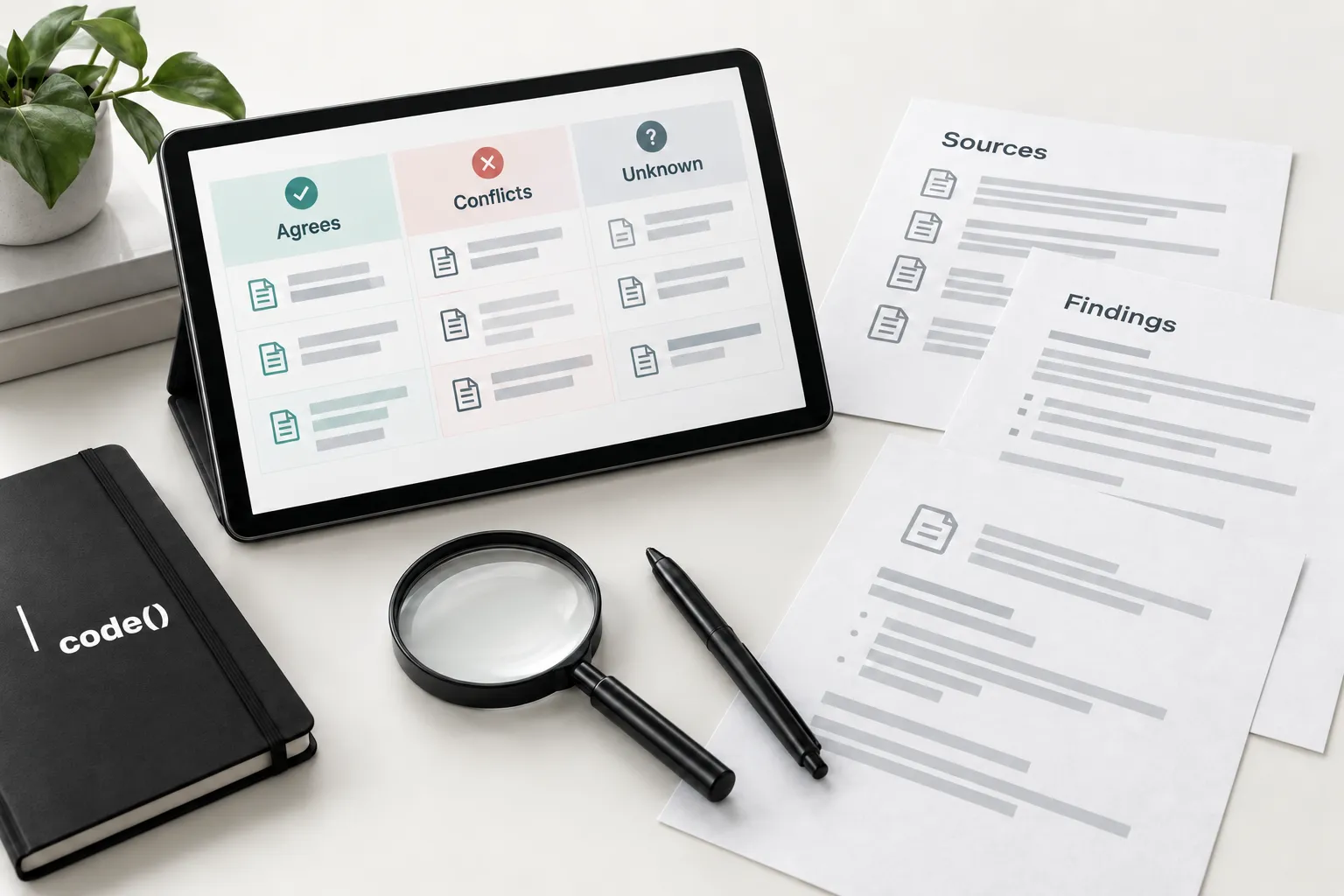
I use a consensus report to find what the evidence supports, where it conflicts and what remains unknown. Agreement between models is not a substitute for agreement between independent sources.
Step 1: Write the decision as a question
Use a bounded question: “Which checkout issue should we investigate first?” Include the market, period and decision deadline.
State what would change the decision. That keeps business intelligence tied to an action instead of an expanding reading list. Our channel framework supplies the wider planning context.
Step 2: Build a source register
Collect original documentation, observed records or research with an inspectable method. Record the URL, publisher, date, scope and relevant passage.
An AI search tool can help locate material: OpenAI web search and Claude web search document source citations. Open those sources yourself. A citation is a pointer, not a completed verification.
Step 3: Trace independence before counting agreement
Ask where each claim originated. If several articles cite the same survey, mark them as one evidence family.
Compare definitions, samples and dates before treating findings as compatible. Do not average values that describe different populations or use different denominators.
Step 4: Classify each finding
| State | Meaning | Action |
|---|---|---|
| Agreement | Comparable independent evidence supports the claim | Use it within that scope |
| Contradiction | Comparable evidence points in different directions | Investigate method or context |
| Unknown | Evidence is missing or not comparable | Name the next check |
These labels describe the evidence collected, not universal certainty. A documented minority finding stays in the report.
Step 5: Challenge the draft
Give a second reasoning pass the source register and draft, rather than asking for another opinion from memory.
Audit this brief using only the supplied sources. For each claim, identify its evidence family, supporting passage and limits. Flag copied evidence, incompatible definitions and conclusions stronger than the records. Do not add facts. List the smallest checks that could change the recommendation.
Step 6: Deliver one usable page
Use this structure:
- Decision: question and scope
- Supported: finding, evidence and limits
- Disputed: competing findings and their methods
- Unknown: missing evidence and next check
- Action: recommendation, owner and review date
Remove any recommendation that cannot survive its own source register. Keep uncertainty visible; the brief should make the decision clearer, not merely sound unanimous.
Sources
- OpenAI web searchdevelopers.openai.com
- Claude web searchplatform.claude.com