
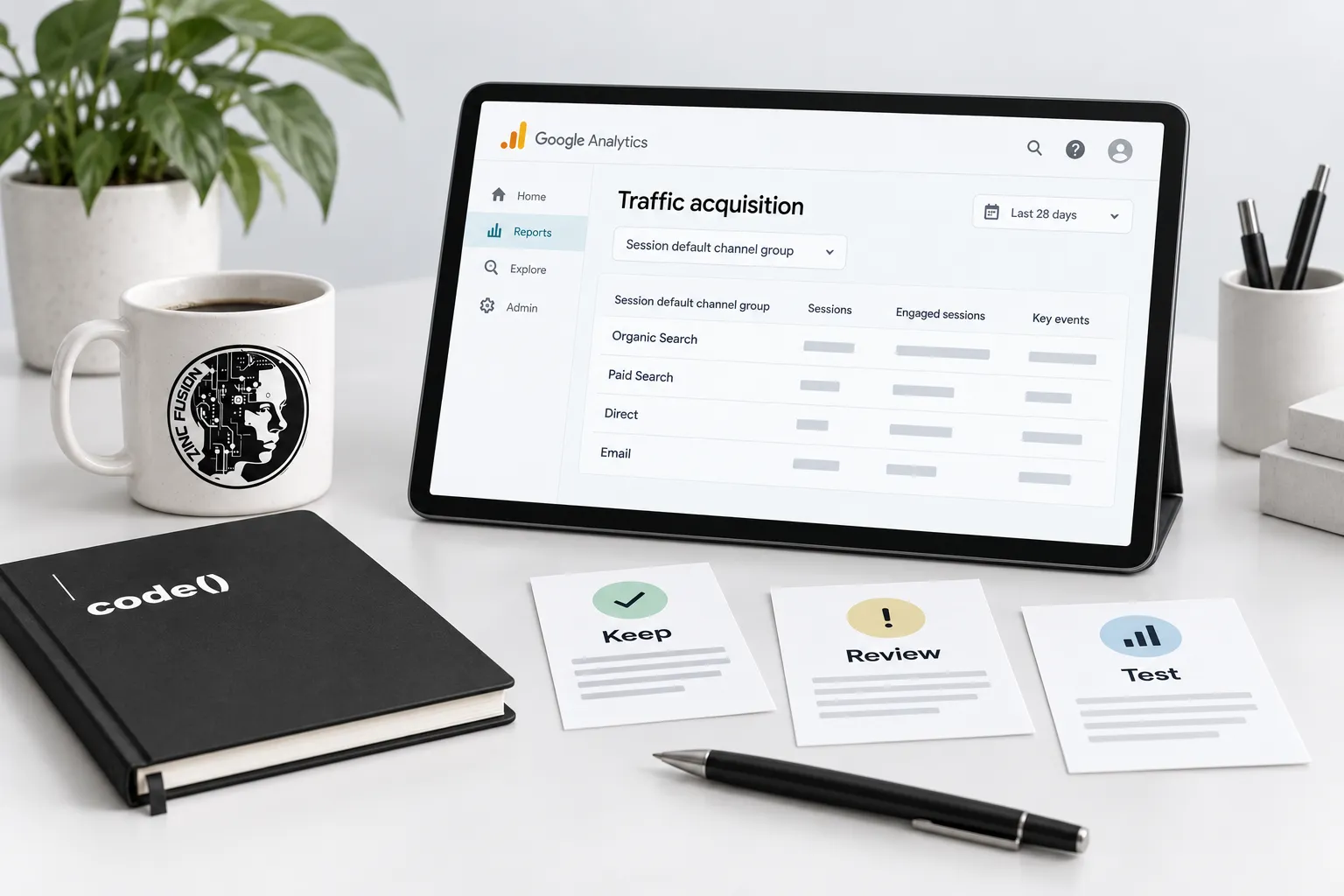
A channel plan needs priorities before it needs platforms.
SEO, paid search, organic social, paid social, email, content, influencer marketing, PR, video, and affiliates all compete for budget and attention. Recommending all of them is easy. Operating them well is the harder decision.
That is not a strategy.
That is a hostage note written by every platform that wants budget.
Most businesses do not need every channel. They need a channel portfolio they can operate well enough to create demand, capture demand, convert demand, and measure whether the money came back.
The hard part is not knowing that the channels exist.
The hard part is deciding which ones to fund, cap, park, or skip.
The Channel Portfolio Rule
A channel deserves serious investment only when it passes five tests.
Test · Question
buyer fit · Does the buyer actually use this channel before making the decision?
economic fit · Can the channel acquire or influence customers inside the acceptable payback window?
operating fit · Can the team feed the channel with the required creative, copy, offers, data, and follow-up?
measurement fit · Can the business see enough signal to make decisions without worshipping vanity metrics?
authority fit · Does the channel strengthen the service, product, local, or ecommerce authority the business needs to own?
If a channel fails one test, cap it.
If it fails two tests, park it.
If it fails three or more, skip it until the business changes.
That sounds harsh. Good. Marketing budgets are not participation trophies.
Fund, Cap, Park, Or Skip
Use this vocabulary before a budget meeting.
Decision · What It Means · Example
fund · give the channel real budget, owner, cadence, measurement, and creative support · SEO for a service business with high-intent search demand
cap · keep it active but limit spend, scope, or time until the constraint improves · paid social with promising creative but weak attribution
park · maintain minimum presence while deprioritizing active work · Instagram for a B2B firm whose buyers are not there to source vendors
skip · stop pretending the channel is part of the growth engine · influencer marketing in a category with no credible creator market
The point is not to be anti-channel.
The point is to be honest about resource allocation.
Gartner’s 2026 CMO Spend Survey says CMOs are pushing into AI while also facing budget and resource constraints. IAB’s 2026 outlook shows digital ad spend still growing, especially in social, connected TV, and commerce media. That does not mean every operator should chase every growth category.
Markets can grow while your channel still fails.
That is the part glossy trend decks forget.
The Seven Channels, Rebuilt As Jobs
The old version of this article listed seven digital marketing channels.
That was useful, but incomplete.
The better way is to assign each channel a job.
1. SEO: Compound Demand Capture
SEO is strongest when buyers already search for the problem, service, product, category, or local need.
Fund SEO when:
- the buyer searches before buying;
- the offer has meaningful lifetime value;
- the site can support service hubs and buyer-intent spokes;
- the business can wait through the crawl, indexation, authority, and content maturity cycle;
- the team will fix technical SEO instead of only publishing posts.
Cap SEO when the site has no service-page ownership, weak technical footing, or no ability to produce useful source-backed content.
Park SEO when the product category has little search demand or the business needs pipeline inside the next few weeks.
Skip SEO only when the economics or buyer behavior make search almost irrelevant. That is rarer than people think, but it happens.
The mistake is asking SEO to do a paid-search job.
SEO is not a panic button. It is an authority system.
2. Paid Search: Immediate Intent Capture
Paid search is the fastest honest test for many businesses because it meets buyers close to the decision.
Fund paid search when:
- the business has clear conversion events;
- lead quality can be measured;
- the landing page is strong enough to convert paid traffic;
- customer value supports the click economics;
- the team can manage negatives, match types, assets, search terms, and conversion quality.
Cap paid search when the account is generating leads but the CRM cannot prove which campaigns produce actual customers.
Park it when CPCs are high and the offer, close rate, or lifetime value is not ready.
Skip it when the math cannot work even with clean tracking and strong pages.
Some categories are simply too expensive for weak economics.
That is not a moral failure. It is arithmetic.
3. Content Strategy: Source Material And Sales Support
Content is not a channel by itself unless it has distribution, search demand, sales usage, or audience behavior behind it.
Fund content strategy when:
- buyers research before contacting sales;
- the business needs to explain complicated decisions;
- SEO hubs need supporting spokes;
- sales needs proof, comparisons, objections, and examples;
- AI-search surfaces need clear, crawlable source material.
Cap content when the team can produce strong pieces but cannot measure impact or connect content to service pages. A content plan tied to pipeline makes that ownership and measurement explicit.
Park it when the business is publishing from habit, not from buyer need.
Skip content volume when the library is already bloated, thin, or disconnected.
Content is supposed to clarify the buying decision.
If it only feeds the calendar, it is office furniture.
4. Organic Social: Trust And Visibility
Organic social works when the audience wants to hear from the business in that environment.
Fund organic social when:
- the company has a visual product, active community, public point of view, or frequent proof to share;
- the founder, experts, or operators can show real work;
- the platform helps build trust before search or sales;
- the team can make native content instead of dumping the same post everywhere.
Cap it when social creates proof but not measurable pipeline.
Park it when the business only needs current profiles, brand legitimacy, and occasional proof.
Skip active posting when the audience is not there, the content is filler, and the team is doing it because someone read that consistency matters.
Consistency matters after relevance.
Otherwise you are consistently irrelevant.
5. Paid Social: Demand Creation And Creative Testing
Paid social can be excellent when the offer is visual, the market is reachable, the creative is strong, and the business understands the measurement lag.
Fund paid social when:
- the product or offer can be understood quickly;
- the audience can be reached with enough precision;
- creative can be refreshed often;
- the business can separate prospecting, retargeting, and existing customer effects;
- the economics support testing before scale.
Cap paid social when the platform reports look strong but CRM or revenue data does not agree.
Park it when the creative pipeline is too weak.
Skip it when the business wants bottom-funnel certainty from a channel designed partly to create demand.
Meta, TikTok, LinkedIn, and other paid social surfaces can make weak ideas look busy. Busy is not profitable.
6. Email And Lifecycle: Retention, Reactivation, And Margin
Email is not glamorous. That is one of its best qualities.
Fund email and lifecycle when:
- the business has customers, subscribers, leads, or repeat purchase behavior;
- segmentation can improve relevance;
- post-purchase, win-back, appointment, review, referral, and renewal flows matter;
- the business can use first-party data responsibly.
Cap email when the list exists but the content or offer quality is weak.
Park it when the business has no permissioned audience yet.
Skip heavy email work when the list is tiny, stale, or legally risky.
Email usually becomes more valuable after another channel creates the relationship. It is often less about acquisition and more about making acquisition less wasteful.
That distinction matters.
7. PR, Influencer, Affiliate, And Earned Media: Borrowed Attention
Earned and partner-driven channels are powerful when credibility transfers from the source to the business.
Fund them when:
- trusted voices exist in the category;
- the business has proof worth covering;
- the audience actually follows those sources;
- tracking can distinguish awareness, assisted demand, and direct response;
- the brand can commit long enough for relationships to compound.
Cap them when they create attention but weak conversion.
Park them when the category has no real creator, trade, partner, or publication ecosystem.
Skip them when the plan is to buy posts from people whose audience quality has not been audited.
Follower count is not distribution.
Sometimes it is just expensive wallpaper.
The Channel Matrix
Here is the operator version.
Business Type · Usually Fund · Usually Cap · Usually Park Or Skip
local service business · Local SEO, SEO, paid search, web conversion · paid social, email follow-up · influencer, broad organic social
Shopify store · Shopify SEO, paid shopping/search, email, CRO · paid social, content, affiliates · PR unless the product has a real story
B2B service firm · SEO, content, LinkedIn proof, conversion pages · paid search, paid LinkedIn · Instagram/TikTok without buyer fit
high-ticket professional service · SEO, content, referral proof, paid search · LinkedIn ads, email nurture · broad creator campaigns
low-AOV ecommerce · email, paid social creative testing, shopping economics · SEO/content by category margin · expensive search terms with weak AOV
new offer with no data · paid search tests, landing page, analytics · SEO planning, content foundations · large organic social calendar
This table is not a universal prescription.
It is a starting argument.
The actual answer depends on margin, sales cycle, geography, product category, creative capacity, conversion rate, and whether anyone can prove what happened after the click. When budgets tighten, use the marketing budget review framework to distinguish what to cut, keep, and prove.
Three Allocation Examples
The decision gets clearer when the channels are tied to real business shapes.
Example 1: Local Service Business With Expensive Leads
Say a local service company wants more booked calls in Miami and Panama City.
The instinct is usually to run search ads, post more social content, start a newsletter, publish blogs, and ask whether TikTok matters.
The better plan is smaller.
Fund Local SEO, service-page SEO, paid search, and landing-page conversion. These channels align with the buyer’s behavior: the customer has a problem, searches by service and location, compares proof, then calls or submits a form.
Cap paid social unless the company has strong before/after proof, seasonal offers, or retargeting audiences.
Park organic social at proof-of-life level: current profile, real work, reviews, project photos, team credibility, and occasional updates.
Skip influencer marketing unless the service category has a real local creator or partner ecosystem.
The operator lesson: local service marketing usually fails because tracking, call quality, reviews, and landing pages are weak, not because the business forgot to post more motivational reels.
Example 2: Shopify Store With Fragmented Demand
For a Shopify store, the channel answer depends on margin and catalog structure.
If collection pages are weak, Merchant Center data is messy, and email flows are barely working, more paid social may only scale confusion.
Fund Shopify SEO, Merchant Center hygiene, collection-page structure, product data, paid shopping/search tests, lifecycle email, and conversion work.
Cap paid social until the store has creative angles tied to real buying reasons, not just product photos with captions.
Park long-form content if it does not support collection pages, buying guides, or comparison decisions.
Skip affiliate or creator work until the store can prove margin, fulfillment, returns, and audience quality.
The operator lesson: ecommerce channel planning is not “which platform has cheap traffic?” It is “which channel can move profitable demand through this catalog without hiding margin problems?”
Example 3: B2B Service Firm With A Long Sales Cycle
B2B firms often overpay for short-term lead capture and underinvest in trust.
If the sales cycle is six months, judging every channel on last-click form fills will make good channels look weak and bad channels look efficient.
Fund SEO, service pages, comparison content, founder or expert point of view, case proof, LinkedIn presence, sales enablement content, and measurement that connects account engagement to pipeline.
Cap LinkedIn ads until the firm can distinguish awareness, retargeting, lead quality, and sales influence.
Park broad paid social unless the audience and offer are unusually clear.
Skip daily generic content if nobody in sales uses it and no buyer would miss it.
The operator lesson: B2B channel planning needs patience and proof at the same time. If the measurement window is too short, the team will cut the channels that create future demand and overfund the channels that merely harvest it.
The Sequencing Rule
Do not fund channels in the order platforms recommend.
Fund them in dependency order.
If This Is Broken · Do This Before Scaling
no clear offer · fix positioning and landing-page copy
weak conversion pages · fix web design, proof, forms, calls, and tracking
bad lead quality · fix paid search queries, conversion events, and CRM feedback
no organic authority · build SEO hubs, technical eligibility, and useful spokes
weak local proof · fix Google Business Profile, reviews, local pages, and service-area signals
messy ecommerce data · fix Shopify collections, product feeds, Merchant Center, and lifecycle email
unclear reporting · build a channel ledger before adding budget
This is why “just spend more” is usually bad advice.
Scaling a broken channel does not make it strategic.
It makes the broken part more expensive.
Keep a decision log beside the budget. Record why a channel was funded, capped, parked, or skipped; which constraint would change the decision; and when the team will review it again. Without that record, old channels come back through memory, politics, stale reports, and panic instead of evidence. Apply that test to the website too: design trends need a business job before they deserve investment.
The Measurement Trap
Bad channel plans usually fail in measurement before they fail in media.
Common problems:
- every platform claims credit;
- GA4 channels are not understood;
- paid search optimizes to shallow leads;
- paid social gets judged only on last click;
- email gets credit for demand other channels created;
- SEO gets judged before technical fixes are indexed;
- sales does not feed lead quality back into marketing;
- Shopify reports revenue but not true contribution by channel;
- local service calls are not tied back to source, landing page, or location.
Google Analytics acquisition reports can help separate user acquisition from session traffic, but only if the business knows what those reports actually mean. Google Ads Performance Max reporting can show channel and goal views, but automation still needs clean conversion value and lead-quality feedback.
The channel is rarely the only problem.
The measurement system is often underbuilt.
AI Changed Channel Planning, But Not The Way People Say
AI did not make channel strategy obsolete.
It made weak channel strategy easier to scale.
AI can help generate ad variants, summarize research, draft outlines, analyze exports, and speed up creative iteration. It can also produce a mountain of average content, average ads, average emails, and average social posts before anyone asks whether the channel deserves attention.
AI search also changes SEO and content planning.
Google’s own AI-feature guidance says the core SEO fundamentals still matter: helpful content, visible text, good page experience, accurate structured data, Search Console verification, and measurement through Search Console and Analytics. AI Mode and AI Overviews can use query fan-out, which means source quality and supporting pages matter more than one isolated article.
The practical rule:
Use AI to improve evidence, speed, and testing.
Do not use AI to justify being in channels the business cannot operate.
The Authority Map Behind Channel Strategy
Every serious channel decision should strengthen a service hub.
For ZINC, the hub is the service system, not the blog archive.
SEO content should support /service/seo/.
Paid search work should support /service/ppc/.
Paid social work should support /service/social-media-advertising/.
Local channel decisions should support /service/local-seo/.
Ecommerce channel decisions should support Shopify SEO, Merchant Center, and collection architecture.
Conversion decisions should support /service/web-design/.
Measurement decisions should support /service/business-intelligence-platform/.
The blog exists to prove judgment, answer buyer questions, and connect those services into a useful operating system.
If a channel article does not point to a service owner, it is just content.
Content without ownership is how marketing teams end up very busy and still confused.
The Channel Kill Criteria
Do not keep a channel alive because it has history.
Use kill criteria.
Kill Or Park A Channel When:
- it cannot be connected to a buyer stage;
- it has no owner;
- it needs creative the team cannot produce;
- it requires data the business does not collect;
- it attracts the wrong leads;
- it cannibalizes branded demand without incremental lift;
- it has no plausible path to payback;
- it weakens service-page authority by scattering effort;
- it creates reporting noise that wastes leadership attention.
Keep A Channel When:
- it has a clear job;
- it is resourced at a professional level;
- it supports a service, product, or market priority;
- it improves the conversion system;
- it produces evidence, not just activity;
- it can be measured on the right timeline.
This is where most channel planning gets uncomfortable.
Some channels are emotionally important because someone on the team likes them.
Some are politically important because a board member asked about them.
Some are socially important because competitors appear active there.
None of those are business cases.
The Prompt To Use
Use this prompt before allocating next-quarter marketing budget:
Act as a marketing channel strategist and operator. Review my channel spend, GA4 acquisition reports, Google Search Console data, ad account exports, CRM lead quality, Shopify or ecommerce revenue if relevant, email performance, social metrics, local search data, service-page map, landing pages, and team capacity. Classify each channel as fund, cap, park, or skip. For each decision, explain buyer fit, economic fit, operating fit, measurement fit, authority fit, payback window, owner, required assets, and the first metric that would prove the decision wrong. Do not recommend every channel. Preserve only the channels that the business can operate and measure well.
The important line is “prove the decision wrong.”
Channel strategy should be falsifiable.
Advanced Prompt
Use this when you have exports and want a stricter triage:
Build a channel-priority ledger from the supplied files. Group traffic, spend, pipeline, revenue, leads, conversion rate, close rate, content assets, landing pages, and service priorities by channel. Identify which channels capture existing demand, create new demand, retain customers, support sales, or mostly produce reporting noise. Recommend a 90-day plan with fund/cap/park/skip decisions, budget movement, tracking fixes, content or landing-page needs, service-hub links, and stop-loss criteria for each channel. Flag any channel where platform-reported performance is not supported by CRM or revenue data.
Do not paste customer data, credentials, private order exports, account IDs, or anything you are not allowed to share.
Use sanitized exports.
The point is not to outsource strategy.
The point is to force the channel plan to defend itself with evidence.
How ZINC Works It
ZINC does not start with a seven-channel checklist.
We start with the business model.
Then we build the channel ledger:
- define the offer, margin, sales cycle, geography, and buyer type;
- map current traffic, spend, leads, pipeline, revenue, and assisted value;
- separate demand capture from demand creation;
- inspect service pages, landing pages, content hubs, tracking, CRM, and email;
- classify each channel as fund, cap, park, or skip;
- map active channels to service owners and hub/spoke content;
- fix tracking before scaling spend;
- set stop-loss criteria before the next invoice cycle.
For SEO, that means authority and patience.
For PPC, that means math and lead quality.
For paid social, that means creative and incrementality.
For Local SEO, that means proof and proximity.
For Shopify SEO, that means product, collection, Merchant Center, and retention systems.
For Web Design, that means conversion.
For Business Intelligence, that means a single source of truth.
The goal is not to do more marketing.
The goal is to stop funding channels that do not deserve oxygen.
The Operator Takeaway
The best marketing channel plan is usually smaller than the one the team wants to present.
Fund the channels with buyer fit, economic fit, operating fit, measurement fit, and authority fit.
Cap channels with promise but weak proof.
Park channels that only need a table-stakes presence.
Skip channels that are running because of habit, anxiety, politics, or platform hype.
You do not win by being everywhere.
You win by being impossible to ignore in the places that actually matter.
Trusted Source Links
- Gartner: 2026 CMO Spend Survey AI budget and readiness findings
- IAB: 2026 Outlook Study ad spend forecast
- IAB/PwC: Internet Advertising Revenue Report, Full Year 2025
- The CMO Survey: 2026 Highlights and Insights Report
- Google Analytics Help: User acquisition vs. traffic acquisition reports
- Google Ads Help: Evaluate Performance Max results
- Google Search Central: AI features and your website
- LinkedIn: B2B Intelligence Hub
- Mailchimp: Email marketing benchmarks
Give each channel a job, an owner, and a decision rule. If it cannot justify the budget, it does not belong in the plan.