
Give each editorial assignment an evidence owner, make room to refresh useful pages, and decide how you will judge the result. Current AI-search reports help you observe visibility; they do not turn an impression or citation into a customer. Commission new work when it fills a real gap, rather than adding another article to an already crowded subject.
Have you ever looked at a beautifully full content calendar and wondered when anyone was going to check what was actually going into it?
The titles are there. The dates are there. Somebody has even colour-coded the thing. It all looks wonderfully organised, until a writer asks who is checking the facts and the meeting becomes rather quiet.
AI discovery gives us a good reason to sort out those less glamorous details. Before we add another article, we need to know what we can explain properly, which useful pages need attention, and how we will tell whether the work has helped.
You can keep your calendar. We are simply going to give it a little more to do.
First, what has actually changed?
Google's June 2026 announcement introduced dedicated generative-AI visibility reports in Search Console. Its update says they reached websites worldwide on 31 August. The reports show impressions within Google's AI search features, giving content teams a more specific observation to discuss than “we seem to be doing something with AI”. Google's reporting announcement
There is also a participation decision to check. Google's Search generative AI control lets a property include or exclude its links and content from the covered features, separately from AI training preferences. Before commissioning a visibility experiment, ask the person authorised to manage the property what the business has chosen. There is little point giving the writer an ambitious brief while leaving that question unanswered. Google's control documentation
Microsoft's AI Performance preview reports citations across supported AI experiences. Microsoft explains that those counts do not establish ranking or position within an answer. So, yes, a citation is worth noticing. It tells you that material has been referenced; it does not tell you that someone visited the website or became a customer. Microsoft's AI Performance announcement
These developments give us more to observe. The interesting bit is deciding what to do with the information, without immediately commissioning another dozen articles.
Give somebody the questions, as well as the title
A title can sound perfectly sensible while hiding quite a few unanswered questions.
Who can confirm the service details? Where are the current product specifications? Does that comparison reflect what the business actually offers? And is there someone available to explain the awkward exception that customers will inevitably ask about?
Put a name beside those questions before the writer starts. “Ask the team” sounds friendly, but it can leave everybody waiting for somebody else.
The evidence need not be elaborate. Depending on the article, you might need an approved service document, a manufacturer's current guidance, a completed example or a conversation with the person who delivers the work. What matters is knowing where the answer comes from and who will check it.
In our client work, we have built separate pages to explain different services. That is useful experience for an editorial brief: each explanation needs someone who knows what the business actually delivers. The writer can make the answer readable, but should not have to conjure up the service details as well. Give them a person to ask, rather than a very optimistic deadline.
Our content-brief guide explains the writing handoff. For the editorial calendar, the useful addition is an evidence owner: the person responsible for helping the writer resolve what is still missing.
If that person cannot confirm the main claim, change the promise or investigate further. A confident introduction will not make an unanswered question go away.
Leave a little room for the pages you already have
A new article is easy to put in the diary. Rechecking an existing page is less exciting, particularly when there is a lovely fresh title waiting for its turn.
But imagine someone comparing your service with another supplier's. They find the guide you published last year, only to discover that the process described there no longer matches the service page. They should not have to work out which version of the business to believe.
Make maintenance assignments specific. Name the information that needs checking, the person who can confirm it, and the pages affected. If delivery terms have changed, for example, the answer may need updating in the commercial page, a guide and a comparison. Giving one introduction a polish will leave the rest of the muddle intact.
Keep those pages connected within the relevant service-aligned blog category. The category houses the articles; the service page explains the offer. A long guide still has its own job to do. Our content-hub walkthrough covers those page roles.
You may still need a new article. Have a look at what is already there first. The next useful assignment might be waiting in your archive.
Shall we try that with an imaginary showroom?
Let's say a fictional kitchen showroom has room for one substantial editorial assignment. This is an illustrative example, not a client project or a measured result.
The first suggestion is “Kitchen renovation trends”. There is already a general inspiration article on the website, so the editor needs a good reason to commission another.
For our example, the brief also says that prospective customers want to know what happens between choosing a design and installation. That question is part of the fictional scenario, not a claim about real customer research.
I would start by asking the project manager to check the showroom's existing process page. Does it explain the stages, dependencies and boundaries of the actual service? Is an important question missing?
The answer might justify a refresh, a new explanation or both, provided the pages have distinct purposes. We do not have to decide on another URL before we have looked.
A useful assignment could say:
Reader decision: Is this installation process compatible with my household's plans?
Evidence needed: Approved scope, project stages, dependencies and the person authorised to confirm them.
Editorial action: Inspect the existing process page before commissioning another URL.
Review trigger: A confirmed service change, or evidence that the explanation is inaccurate or incomplete.
There is no invented installation timetable to make the example look finished. The business needs to supply that information. Nobody wants to discover that their carefully planned kitchen schedule began with a writer having a guess.
Now the calendar has a proper assignment: a reader's question, a source of evidence and a reason for the work.
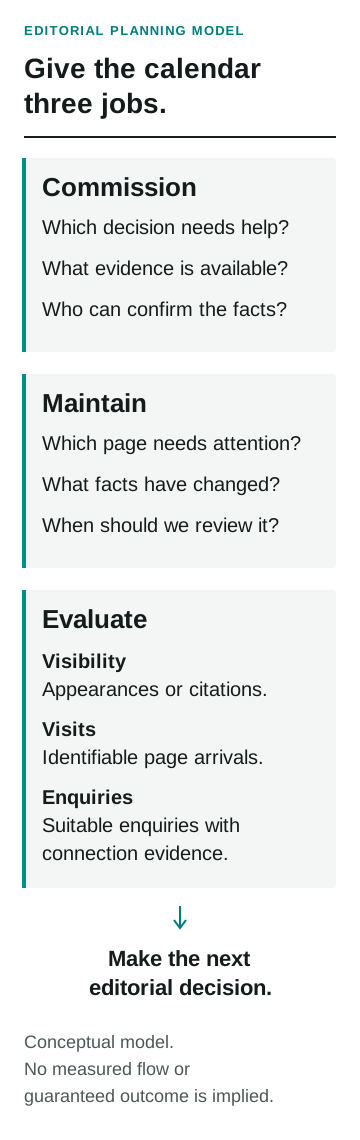
This is an editorial planning model, not a measured conversion funnel. Each part is explained in the article.
Before we admire the numbers, what are they telling us?
Decide what you want to learn before publication. It is much easier to judge the work fairly when you have not already become rather fond of whichever number looks best.
Visibility: Has the page appeared or been cited in the source you are examining? Google's generative-AI Search report is an impressions view, and its data is also included in overall Search reporting. Do not add the two together as separate audiences. If the dedicated report is missing, check its documented eligibility and access conditions before treating the absence as zero visibility. Google's report documentation
Visits: Have people reached the page? Look at the available referral and landing-page evidence. Keep the visits you can identify, and leave the rest unattributed. We cannot assign them to an AI product simply because the dates happen to look promising.
Enquiries: Has the business received suitable enquiries, and what evidence connects them with the page? Keep the definition consistent. Someone reading an article, submitting a form and becoming a qualified opportunity are different observations.
You want to understand how these observations relate. You do not want to bundle them into one reassuring total.
More citations without identifiable visits could prompt a review of what is being referenced and why. Visits without suitable enquiries suggest another line of investigation: does the page help the right reader understand the offer and take the next step? Neither pattern, by itself, supplies the answer.
For a repeatable AI-answer sample, record the exact prompt, platform, date and time, cited URLs and whether the answer is factually accurate. Keep the context as consistent as possible and note changes. The sample describes those observations, rather than everyone's experience of the platform.
The AI-content strategy guide explains the publishing and observation workflow. Here we are deciding what the findings should change in the calendar. Sometimes that will be a new assignment. Sometimes a specific correction is enough.
A few things to check before giving the writer more work
If a fact is wrong, correct it. If an existing answer is hard to find, look at the links from the relevant category. If the proposed article has no evidence owner, finish that part of the brief first.
Those are sensible editorial decisions. We cannot promise that a platform will reward each one with a citation or a customer.
Permission and access questions need their own owner, too. OpenAI documents separate controls for OAI-SearchBot, used for search, and GPTBot, associated with training. The business's training preference should not be changed casually as part of an article experiment. OpenAI's crawler documentation
Ask the authorised person to confirm the position and keep that decision with the evidence record. Otherwise, we may be trying to judge an experiment without knowing what was available to be discovered.
Bring one proposal and one existing page
For the next editorial meeting, choose one proposed assignment and one useful page already on the website.
| What you find | Editorial decision | What closes the assignment |
|---|---|---|
| A useful answer exists, but its service details are out of date | Refresh that explanation and any connected pages affected by the change | The responsible person confirms the facts and checks the published pages |
| A distinct customer question has no useful answer, and evidence is available | Commission an article within the relevant service-aligned category | The article answers the question, shows an example and gives a useful next action |
| The proposed claim cannot yet be supported | Assign the missing check before commissioning the claim | The evidence owner supplies a source or narrows the promise |
For each, write down the customer decision, the evidence owner, the current gap and the next observation that would change your mind. The editorial decision register includes a blank row and a labelled example to help you get started. Open it in your spreadsheet app, keep the example separate and duplicate the blank row for each real proposal. At the next review, check whether the named person supplied the evidence and whether that changed your decision; leave results you have not observed marked as pending.
Then decide what deserves the time. You might commission something new, refresh a particular explanation or leave a useful page alone.
If you need help checking the discovery side, our Generative Search Optimization service is a sensible next conversation. Bring the customer question, the pages you already have and the evidence still missing. You can browse the related service-aligned articles before you put anything else in the diary.
There is no need to fill every available date before you have answered those questions. Give the evidence a little room. The calendar will cope.
Sources
- Google's reporting announcementdevelopers.google.com
- Google's control documentationsupport.google.com
- Microsoft's AI Performance announcementblogs.bing.com
- Google's report documentationsupport.google.com
- OpenAI's crawler documentationdevelopers.openai.com