
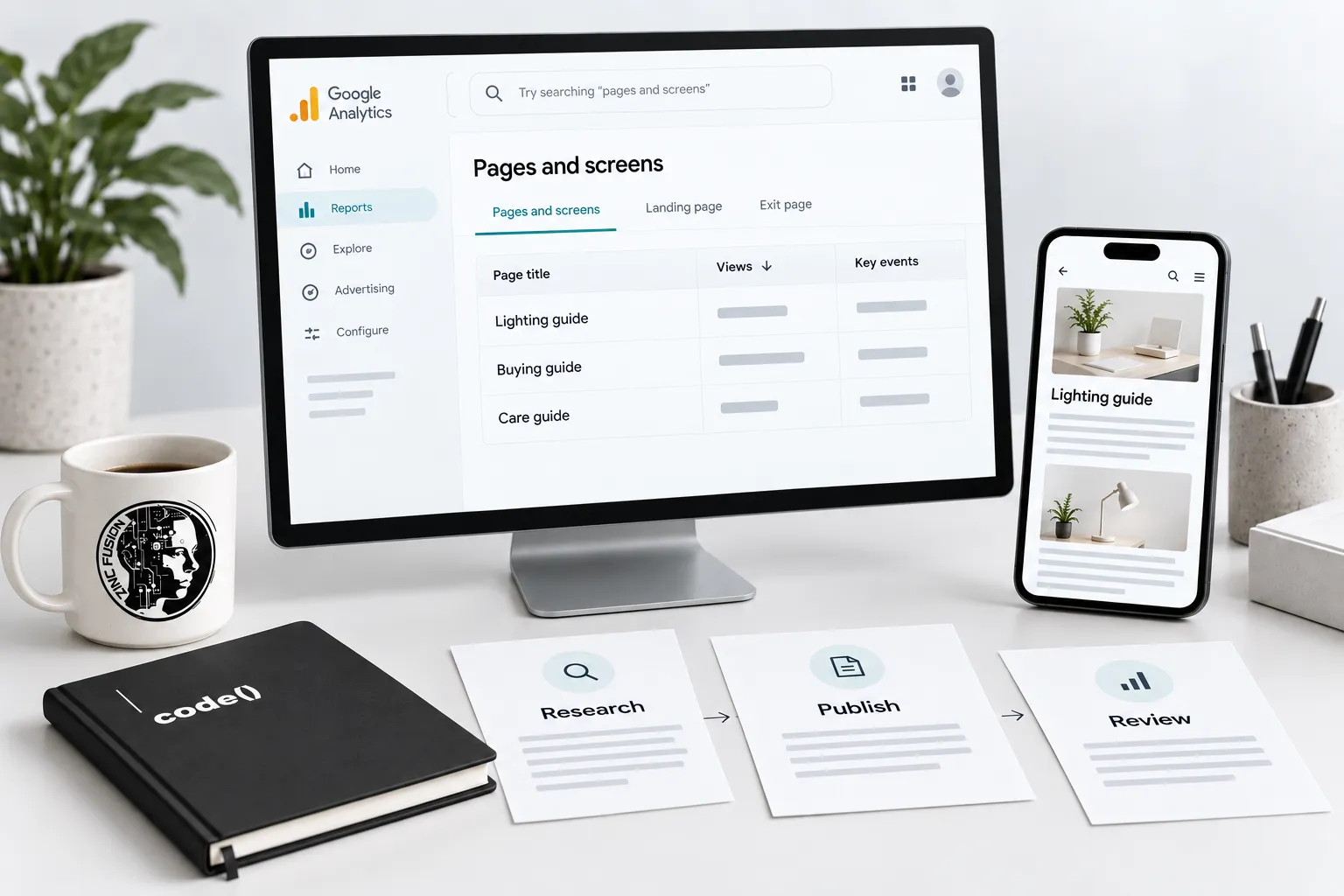
Choose a service or product collection, create its blog category, then assign distinct customer questions to articles within it. Connect useful answers to the relevant commercial page. Track qualified inquiries and sales progress without crediting every assisted visit as a new sale.
A publishing calendar tells you when an article is due. It does not tell you why a customer would need it.
Build the plan around the services or products you actually sell, the questions customers ask before buying and the evidence your team can provide. Then assign the writing. This order saves a remarkable amount of editorial wandering.
Start with one commercial priority
Choose a service or product collection the business wants to support. Confirm that it has a useful commercial page and that someone can handle the resulting enquiries. More traffic to an unclear offer is not much of a plan.
Before commissioning anything, gather the current pages, recent customer questions, available Search Console data and approved examples. Separate observed customer needs from assumptions. If you have no search data yet, say so and start with documented enquiries rather than inventing demand.
Define the pillar, category and articles
For this plan, use a service-aligned category overview as the pillar. Give every article one explicit primary service and the matching pillar. A comprehensive guide can also be a pillar page in other content models; keep your chosen structure consistent.
The service or collection page explains the offer. The category helps readers browse the related advice. Individual articles answer distinct questions. Every article links directly to its pillar and primary service. The pillar lists its articles; the service links back to the pillar and relevant guidance. Add useful peer links without making every article repeat the same sales paragraph.
For the complete architecture and printable planning tools, use our content hub guide.

Worked example: a business reporting service
This is an illustrative plan, not a claim about client results.
| Page | Reader’s question | Useful next step |
|---|---|---|
| Business intelligence service | Can someone help us build reliable reporting? | Explain scope and start an enquiry |
| Business intelligence blog category | What should we understand before commissioning reporting? | Browse the related guides |
| KPI definitions article | Why do our reports disagree on revenue? | Complete a metric definition sheet |
| Data preparation article | What records should we supply? | Gather sources, permissions and sample records |
| Dashboard review article | How do we check that a report is useful? | Test one decision against the underlying records |
The three articles have different jobs. One resolves a definition problem, another prepares the project, and the third helps assess the result. They need different examples, not three versions of an introduction to dashboards.
Write the brief before the draft
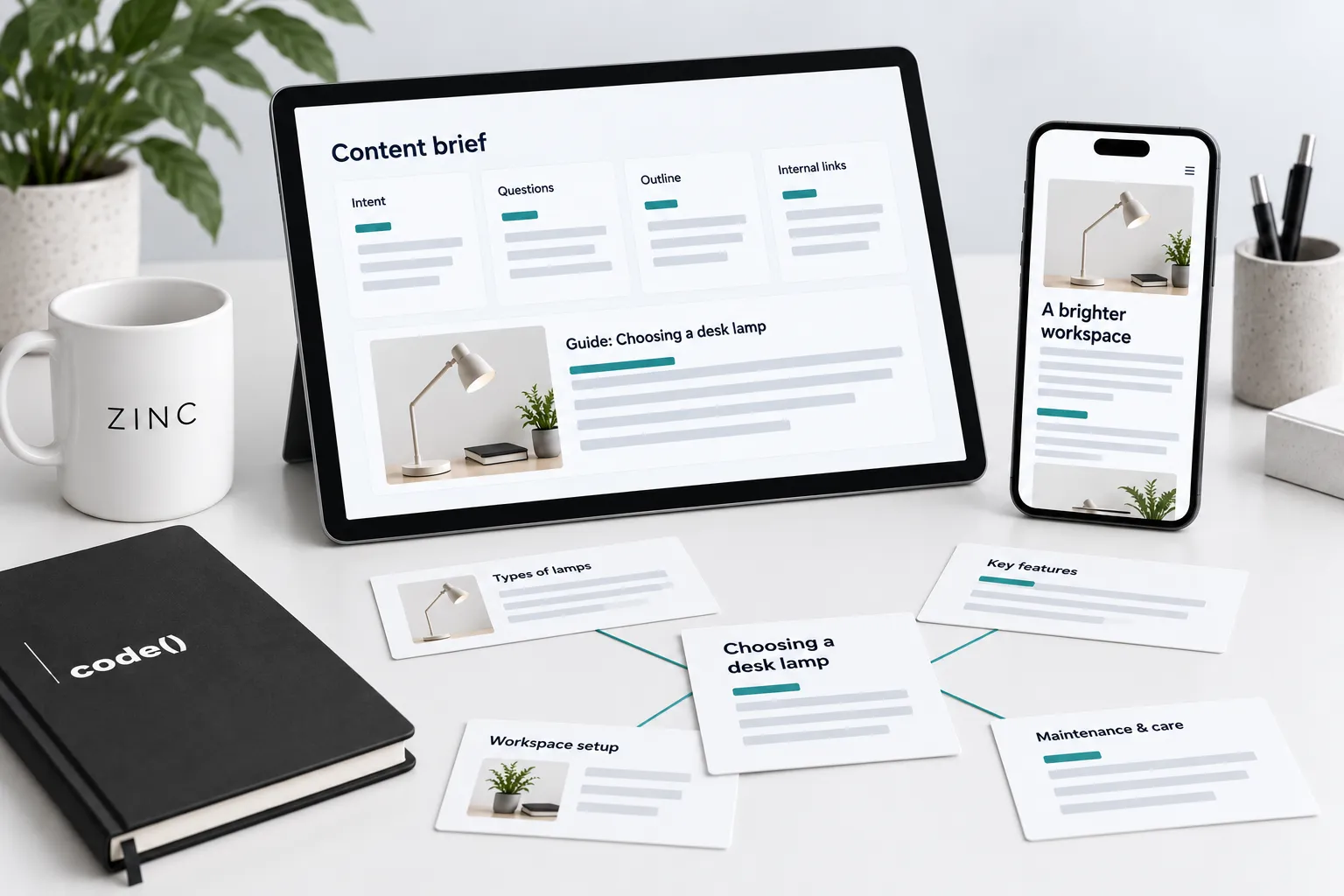
For each assignment, record the reader, main question, intended action, primary service, pillar and service URLs, evidence, section outline and links. Name a factual reviewer. Mark information you still need; do not quietly fill it with plausible claims.
A good brief specifies a usable deliverable. For the revenue example, that means a completed definition showing gross versus net revenue, discounts, refunds, tax, currency and date basis. See the content brief walkthrough for a filled example.
Google’s people-first content guidance is a useful editorial check: the page should help its intended reader and contribute something beyond a restatement of other pages. There is no useful word-count target for every assignment.
Put distribution and maintenance on the same plan
Choose where each article will be useful: a relevant sales follow-up, an existing customer email, a category archive or another article answering the preceding question. Obtain any necessary communication approval before sending material.
Set a maintenance trigger. A product specification change, revised platform documentation or recurring customer misunderstanding can justify an update. A fresh date alone cannot.
Here is a four-week illustrative sequence for that reporting service. It demonstrates the work involved; it is not a publishing-frequency prescription.
| Week | Delivery and owner | Distribution and next step | Capacity |
|---|---|---|---|
| 1 | Content lead inventories existing pages; service owner confirms the offer and tests enquiries | Connect the service and category; save the measurement baseline | Two review hours and two publishing hours |
| 2 | Writer drafts the metric-definition article; finance reviewer checks the example | Link from the relevant existing reporting guide; use an approved customer email where useful | Five writing, two review and one publishing hour |
| 3 | Writer explains source preparation; delivery lead checks access requirements | Link from the definition article; use in relevant sales follow-up | Five writing, two review and one publishing hour |
| 4 | Writer demonstrates dashboard acceptance; delivery lead checks the sample | Add to the category and preparation article; invite readers to complete the check | Five writing, two review and one publishing hour |
That plan reserves 28 hours before any new photography or paid promotion. Multiply each role's hours by the business's actual internal or supplier rate; add separately quoted artwork and distribution costs. If only 12 hours are available, reduce the number of assignments or extend the sequence. Removing factual review is not a sensible capacity saving.
The content lead owns the calendar and links. The service owner owns enquiry follow-up. Each reviewer names the trigger that would make their article stale, such as a changed definition, access requirement or repeated buyer misunderstanding. A missed deadline changes the schedule; it does not justify publishing an unfinished guide.
Download the publication and distribution plan. The spreadsheet-ready CSV includes this example and a blank row for your own assignments. Use the brief worksheet for the individual writing jobs.
Measure progress without inventing attribution
Use Search Console for the queries and pages that appear in Google Search. Its Performance report is not a complete record of people or sales. Use your inquiry or sales records to assess whether the resulting conversations fit the business.
Define the commercial measures before filling the report:
- Valid enquiry: a distinct, reachable person asking about a real reporting need; exclude spam and duplicate submissions.
- Qualified opportunity: a valid enquiry that meets the team's agreed service fit and has a recorded next sales step. Define the fit criteria before reviewing results.
- Pipeline value: the value of those opportunities under the business's own sales-stage rules. It is not booked revenue.
- Content connection: retain the available referral or campaign evidence and the person's answer to “What prompted you to contact us?” Keep unknown origins unknown.
Illustrative month: eight valid enquiries include three qualified opportunities. Two people mention an article, but one also arrived through a referral. Report those observations without crediting the article with all eight enquiries or counting one person twice. Compare the questions asked, preparation quality and eventual sales stages as well as search visits. A four-week launch is a starting point for measurement, not proof that content caused pipeline growth.
At the review, decide whether to improve an existing answer, produce the next missing guide or stop an assignment that no longer has a purpose. Use the BI category for related measurement guidance and the channel planning guide to place content alongside other marketing activity.
Before the first article goes live
- Each article has one primary service and its matching pillar.
- The commercial page explains the offer and the enquiry path works.
- Every article has a distinct reader question and reviewed evidence.
- Examples are real and approved, or clearly labelled illustrative.
- Each article links to its pillar and service; both offer useful routes back.
- A person owns the review date and the measurement definitions.
If you cannot identify the decision an article helps someone make, improve the brief before adding it to the calendar.
If the plan needs implementation, our SEO service is the relevant starting point for search content. Bring the service-aligned category, distinct article questions and evidence owners; agree the work before filling more calendar slots.
Sources
- people-first content guidancedevelopers.google.com
- Performance reportsupport.google.com