
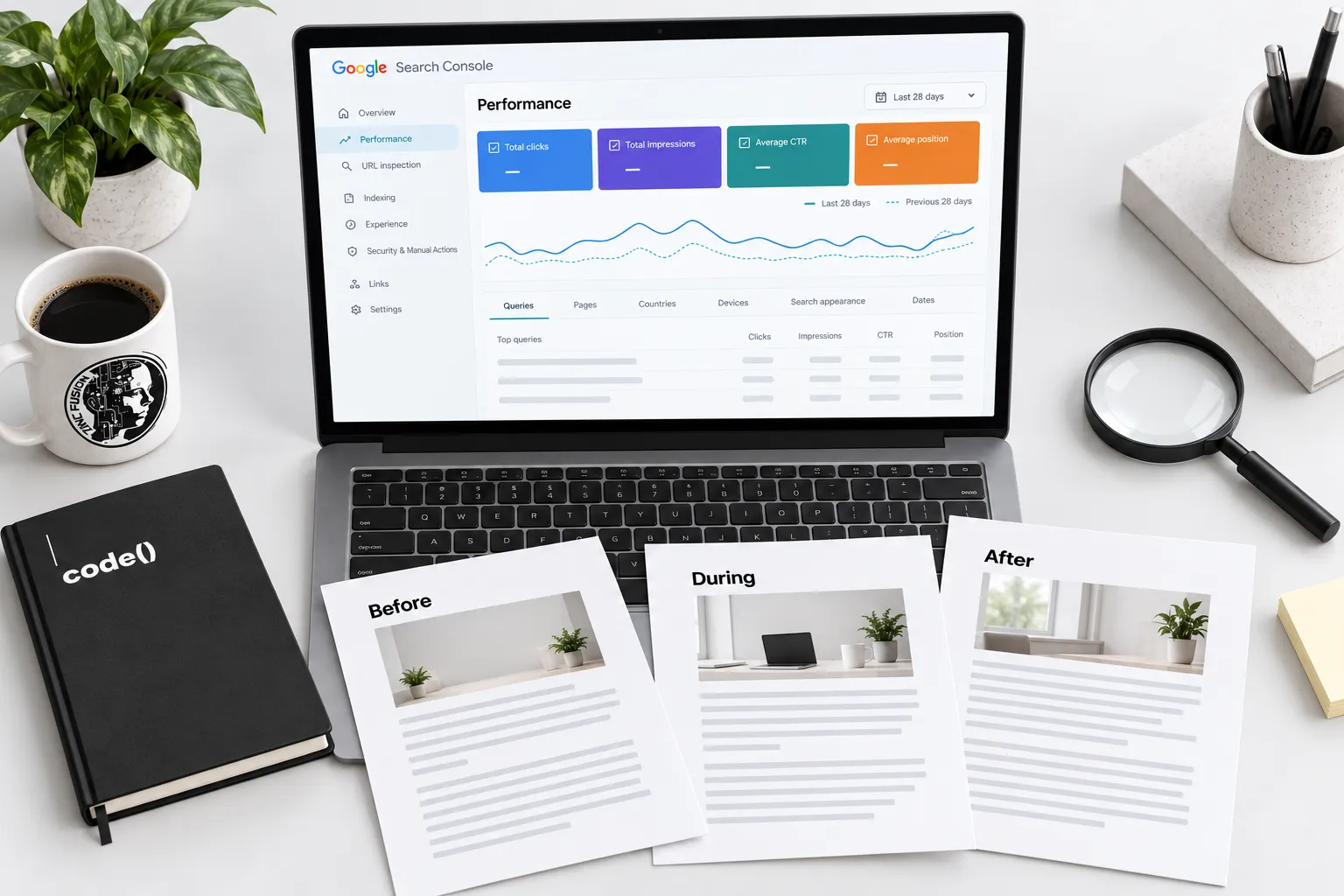
An algorithm-update calendar tells you what Google announced.
It does not tell you what to fix.
The useful record connects the announcement to the pages that moved, the changes already shipped, and the repair that comes next.
From 2023 through 2026, the durable pattern is clear: Google kept making weak SEO systems harder to hide. Thin content, anonymous authorship, scaled output, unclear service-page ownership, duplicate URL structures, low-trust ecommerce, and content written for search engines instead of buyers all became more expensive.
The named updates matter less than the direction. Use the four pillars of SEO to connect that direction to the work.
Search became less forgiving.
The Movement Ledger
Use this as the working summary.
Shift · What Changed · What Operators Should Fix
helpful content became harder to isolate · quality systems moved from a named event into the broader core-update environment · usefulness, author lanes, original examples, source support
spam policies became more explicit · scaled content, expired domains, and site reputation abuse became harder to defend · remove manipulation, consolidate weak pages, stop rented-authority tactics
AI search changed click economics · AI Overviews and AI Mode affected informational behavior and source selection · build citation-worthy source pages and measure page/query movement
service-page ownership mattered more · generic blogs stopped carrying commercial SEO alone · map hubs and spokes to the actual service pages
technical debt surfaced faster · canonical, crawl, duplicate, and template issues became easier to expose · fix eligibility before content volume
authority became less performative · bylines alone were not enough; real evidence and topic depth mattered · show proof, credentials, local trust, ecommerce data, and internal links
The ranking movement was not one magic factor.
It was systems getting stricter.
2023: Helpful Content Became The Warning Shot
The 2023 search environment made one thing obvious: content written only to fill a keyword map was no longer a durable asset.
The September 2023 Helpful Content Update hit many sites because it evaluated patterns across a site, not only isolated pages. That made the old playbook riskier:
- hundreds of shallow articles;
- generic “ultimate guide” formats;
- anonymous editorial-team pages;
- AI-assisted output with no operator judgment;
- articles that repeated public information without adding examples;
- topic clusters with no commercial hub or internal-link logic.
The lesson was not “AI content is banned.”
Google’s own guidance has said automation is not the issue by itself. The issue is content made primarily to manipulate rankings rather than help people.
The operator lesson was sharper:
If the site cannot explain why a page exists, Google eventually may not either.
2024: The Quality And Spam Reset
March 2024 was not just another update.
Google announced a broad core update and new spam policies that directly addressed scaled content abuse, expired domain abuse, and site reputation abuse. Helpful content signals were also no longer something operators could treat as a separate named system.
That changed how recovery had to be planned.
You could no longer ask only, “Which page dropped?”
You had to ask:
- does the site have too many weak pages?
- are there sections that exist only for search traffic?
- are authors real and credible?
- does the content demonstrate first-hand knowledge?
- is the site borrowing authority through third-party content?
- are old domains, subfolders, or partnerships being used to rank content that does not belong there?
- are pages consolidated around clear hubs?
That was the year many operators learned the difference between content volume and content authority.
2025: AI Search Changed The Interface
AI Overviews and AI Mode did not replace SEO.
They changed the interface around SEO.
Informational queries became less reliable as click sources. Source selection, summary behavior, follow-up exploration, and query fan-out made simple ranking reports less complete. A page could still rank and earn fewer clicks. Another page could become strategically valuable because it supported source authority, even if it was not the last-click conversion page.
For operators, 2025 changed the question:
Not just “do we rank?”
Also:
- are we a source worth citing?
- do our pages support each other?
- does the service page clearly own commercial intent?
- do supporting articles answer adjacent buyer questions?
- are authors, examples, and sources visible?
- do we measure impressions, CTR, conversions, and assisted value separately?
The SEO industry tried to rename everything AEO, generative search optimization, or AI SEO.
Most of the durable work was still SEO: crawlable pages, useful content, trusted entities, internal links, clean architecture, and clear commercial ownership.
2026: Core Updates Meet AI-Search Measurement
By 2026, operators had two simultaneous problems.
Core updates were still reassessing quality and relevance. AI search was also changing how some searchers interacted with results. That made attribution harder.
The March 2026 core update and March 2026 spam activity reminded operators that Google’s quality and spam systems were still moving. The May 2026 core update arrived while AI Mode and AI Overviews were also expanding. Search Console still reports AI-feature traffic inside the Web search type, so clean AI attribution is limited.
That means the right retrospective is not:
“Google update caused everything.”
The right retrospective is:
“Which page groups moved, which query classes changed, and which business metrics followed?”
What Actually Moved Rankings
The durable movers were not mysterious.
1. Useful Pages With Real Ownership
Pages that had a clear job held up better.
Examples:
- a service page that owns a commercial query;
- a local page that proves service-area relevance;
- a Shopify collection that organizes products cleanly;
- a technical guide with real diagnostic examples;
- a content piece that supports a service hub instead of floating alone.
Weak pages got less room to hide.
2. Topic Systems, Not Isolated Posts
One post rarely carries a competitive topic anymore.
The stronger sites had hubs, spokes, internal links, and page roles. The service page owned the buyer intent. Supporting content answered questions around the decision. Technical pages explained the problems. Local pages proved geography. Ecommerce pages connected product data to collection intent.
That is what a search system looks like.
3. Author And Entity Trust
Author names alone did not magically rank pages.
But anonymous, generic, and low-proof publishing became weaker. Named authors, clear expertise, company context, source links, original examples, and consistent topic ownership helped search systems understand why the page should be trusted.
The lesson is not to paste a bio under every post.
The lesson is to make expertise visible in the content.
4. Technical Eligibility
Technical SEO did not become less important.
It became easier to expose when ignored.
Updates did not forgive:
- duplicate URL patterns;
- wrong canonicals;
- body H1s fighting templates;
- orphaned commercial pages;
- stale redirects;
- bloated templates;
- broken structured data;
- Shopify filter chaos;
- city pages with doorway patterns;
- sitemap and indexation drift.
Better content cannot fully rescue broken eligibility.
5. AI-Search Source Quality
AI Overviews and AI Mode created pressure for source quality.
Current research on AI Overviews shows that source selection, answer synthesis, and publisher impact are not the same as classic blue-link ranking. But the work still overlaps heavily with good SEO: useful sources, authority, internal links, evidence, clear entities, and pages that answer specific questions.
You cannot optimize for an AI citation if the page is generic.
What Was Mostly Noise
Not every update needed a strategy meeting.
These often created more noise than durable movement:
- unconfirmed volatility;
- rank-tracker spikes without Search Console movement;
- one-query dips;
- social posts declaring winners before rollout completion;
- broad “AI killed SEO” claims;
- tactic lists that ignored page groups;
- schema hacks unsupported by visible content;
- changing slugs to chase freshness;
- mass rewrites during active rollouts.
Noise becomes expensive when the team reacts to it.
Year-By-Year Movement
A useful retrospective needs time slices.
2023: The Content Factory Warning
2023 showed how fragile search traffic can be when the site depends on broad informational content without strong ownership.
The warning signs were visible before many sites dropped:
- articles created from keyword variations instead of user problems;
- shallow topic clusters with no commercial hub;
- weak author pages;
- no original examples;
- no real source links;
- heavy reliance on affiliate, review, or summary formats;
- old content refreshed only by changing the year.
When helpful content pressure increased, those patterns became expensive.
Operators who already had real service pages, real author lanes, original examples, and useful internal links had less to unwind. Operators who built around volume had to decide whether to improve, consolidate, noindex, redirect, or remove large parts of the library.
2024: The Spam And Quality Reset
2024 turned soft warnings into harder policy lines.
Scaled content abuse, expired domain abuse, and site reputation abuse were not abstract ideas. They described real tactics many sites had used to borrow authority, manufacture scale, or rank content that did not belong on the host site.
For legitimate service businesses, the practical lesson was still useful:
- stop renting credibility;
- stop hiding thin content in large libraries;
- stop treating author boxes as proof;
- stop using programmatic pages without real utility;
- stop letting archives, tags, filters, and doorway-like city pages clutter the index.
Good sites did not need to become less ambitious.
They needed to become cleaner.
2025: The SERP Became Less Click-Predictable
By 2025, AI search made a simple ranking report less complete.
A page could hold position and lose clicks. A page could earn impressions but see weaker CTR because the result page changed. A source could become valuable because it supported an AI answer or a broader topic cluster, not because it was the last click before conversion.
Operators had to measure differently:
- impressions by page;
- CTR by query class;
- branded versus non-branded demand;
- informational versus commercial pages;
- conversions by service page;
- assisted value from content;
- source quality and internal links.
This is where many “SEO is dead” takes failed.
What died was the lazy idea that traffic volume alone proves content value.
2026: The Measurement Layer Got Harder
In 2026, AI-search features, core updates, and spam systems overlap in the same operator dashboard.
That means the same page can be affected by:
- quality reassessment;
- AI Overview presentation;
- changed query behavior;
- stronger competitors;
- stale content;
- technical debt;
- weaker internal links;
- conversion-page problems;
- local or ecommerce shifts.
Attribution got harder.
The response needs to get more disciplined, not louder.
The Six Durable Repairs
After reviewing the 2023-2026 pattern, the repair list is not mysterious.
1. Clean The Index
Remove or consolidate pages that should not compete.
That includes duplicate posts, weak tag archives, thin city pages, faceted ecommerce URLs, outdated yearly refreshes, and no-value utility pages. A cleaner index gives strong pages a better chance to own intent.
2. Rebuild Service Hubs
Every commercial topic needs a clear owner.
The service page should own the buyer intent. Supporting articles should link into that page. Technical guides, local pages, ecommerce pages, and comparison content should all have a role. If the site cannot say which URL should win, Google may choose for it.
3. Add Evidence To Content
Evidence means more than sources.
It includes examples, screenshots where useful, named authors, operating judgment, original frameworks, local proof, product data, case context, and clear next steps. Thin content became weaker because it lacked evidence, not because it lacked word count.
4. Fix The Technical Floor
Technical SEO is the eligibility layer.
If the page is canonicalized wrong, rendered poorly, blocked, duplicated, orphaned, slow, or polluted by template issues, content quality has a lower ceiling.
The update era did not make technical SEO optional.
It made technical debt easier to expose.
5. Strengthen Local And Ecommerce Proof
Local SEO and Shopify SEO both require specific proof.
Local pages need geography, reviews, service-area clarity, local internal links, and Google Business Profile alignment.
Shopify pages need collection architecture, product data, internal links, canonical control, Merchant Center hygiene, and buying-guide support.
Generic blog content cannot replace either system.
6. Measure Movement By Page Group
Whole-site traffic is too blunt.
Measure service pages, local pages, Shopify collections, product pages, topic clusters, and informational posts separately. Then compare impressions, clicks, CTR, rankings, conversions, and revenue by group.
That is how you find what actually moved.
Service-Specific Lessons
SEO
The SEO lesson is service ownership.
A strong SEO program decides which page owns which buyer intent. Algorithm updates exposed sites where commercial pages were weak and blogs were asked to do too much.
Technical SEO
The technical lesson is that eligibility still matters.
No amount of content strategy fixes bad canonicals, crawl waste, duplicate URL patterns, broken templates, or orphaned priority pages.
Local SEO
The local lesson is trust density.
Reviews, local pages, city relevance, mobile UX, service-area proof, and business-profile consistency became more important as generic national content got easier to produce.
Shopify SEO
The Shopify lesson is collection ownership.
Products, filters, variants, collections, buying guides, and Merchant Center data need to tell one story. If the store fragments demand, updates expose the fragmentation.
Web Design
The design lesson is that pages must both rank and convert.
A page can survive an update and still waste traffic. Template quality, content visibility, speed, form clarity, and offer structure affect whether organic demand turns into pipeline.
Content Strategy
The content lesson is role clarity.
Every asset should support a hub, answer a buyer question, prove expertise, or help a sales conversation. If a page only exists because a keyword tool found a phrase, it is vulnerable.
The Movement Matrix Example
Here is how an operator should translate the retrospective into a working matrix.
Movement · Bad Interpretation · Better Interpretation · Action
blog impressions down, service leads steady · Google punished the site · informational clicks got less valuable · improve only useful support articles
service pages down, blogs steady · core update mystery · commercial pages may be weaker than competitors · compare service pages and repair proof
collections down, products steady · ecommerce SEO is broken · collection ownership may be weak · fix collection content, canonicals, and links
local pages down on mobile · update hurt local SEO · mobile UX or local proof may be weaker · audit local pages, GBP, reviews, and mobile
impressions up, CTR down · rankings are worse · SERP presentation or AI features may be changing clicks · inspect queries and titles by page
all pages down after migration · Google update caused it · site change may have broken signals · audit redirects, canonicals, templates, and tracking
The matrix forces the site to prove the cause.
It also stops a common mistake: treating every change as a content rewrite.
What Not To Overlearn
Every era of SEO creates bad lessons.
Do not overlearn these:
- “Long content wins.” Some long content is useless. Some short content is decisive.
- “AI content loses.” Low-effort content loses. AI-assisted work still needs editorial judgment, original examples, and source support.
- “Schema fixes rankings.” Schema helps describe legitimate visible content. It does not make a weak page strong.
- “Brand solves everything.” Brand helps, but weak pages can still underperform.
- “Core Web Vitals are everything.” Page experience matters, but it does not replace usefulness, relevance, and authority.
- “Google hates small sites.” Many small sites lose because they imitate large content farms without having large-site authority.
- “More posts means topical authority.” More useful, connected, source-backed pages can build authority. More weak pages can dilute it.
The better lesson is less dramatic:
Google kept rewarding sites that looked more like real operators and less like SEO output machines.
What To Do Before The Next Retrospective
Do not wait another year to find out what moved.
Set the measurement system now:
- annotate major updates, launches, migrations, and content releases;
- maintain a clean Search Console export habit;
- tag pages by role: service, local, Shopify collection, product, post, archive;
- track internal links to priority pages;
- maintain a canonical and redirect ledger;
- monitor authorship and source quality;
- review thin pages quarterly;
- separate branded from non-branded growth;
- map content to revenue influence, not only sessions.
This turns the next retrospective into analysis instead of archaeology.
When the record is clean, the lesson is easier to find.
The Retrospective Audit
To understand how updates affected a site from 2023 through 2026, build a retrospective audit.
Audit Layer · Question
page groups · Which service, blog, local, product, collection, and archive pages moved?
query classes · Which branded, non-branded, local, commercial, informational, and transactional terms changed?
content quality · Which pages are thin, generic, stale, or unsupported by examples?
service ownership · Which commercial pages should own demand but do not?
internal links · Which spokes actually support the hub?
technical state · Which pages are blocked by indexation, duplicate, canonical, or template issues?
AI-search exposure · Which informational pages saw impression/CTR shifts consistent with AI features?
business impact · Which changes affected calls, leads, sales, or assisted conversions?
This is better than update-by-update panic.
It asks what changed across the system.
The Authority Map Behind The Repair
The best retrospective ends with an authority map, not a list of edits.
For ZINC, the SEO hub should explain the ranking system and own the strategic decision. Technical SEO spokes should prove crawl, indexation, canonical, schema, template, and performance eligibility. Search Console spokes should explain how the movement was measured. Local SEO spokes should cover proximity, profile trust, service-area clarity, reviews, and city-level demand. Shopify SEO spokes should own collection architecture, product data, merchant eligibility, faceted navigation, and PDP support. Content strategy spokes should turn weak topical coverage into useful decision assets with examples, sources, and internal links. Web design spokes should connect ranking recovery to the pages that actually convert.
That map matters because Google updates rarely punish one isolated paragraph. They expose whether the site has an understandable system of authority around the services it wants to sell. If a repair cannot be mapped back to a hub, spoke, service owner, and measurable business outcome, it is probably cleanup, not strategy.
How ZINC Works It
ZINC reads algorithm history as an operating pattern.
We do not chase every announcement.
We build the movement ledger:
- map update dates to Search Console and analytics periods;
- segment page groups by service, local, ecommerce, content, and technical role;
- separate ranking movement from CTR and conversion movement;
- identify pages that lost because they were weak versus pages affected by SERP presentation;
- repair technical eligibility before content volume;
- rebuild content around service hubs and buyer-intent spokes;
- preserve live slugs and redirects unless a migration plan proves otherwise;
- measure the next leading indicator before changing another surface.
For SEO, that means service-page authority.
For Technical SEO, that means crawl and index eligibility.
For Local SEO, that means city pages, reviews, service areas, and mobile search.
For Shopify SEO, that means collection ownership, product data, canonical control, and merchant surfaces.
For Web Design, that means conversion and crawlable templates.
For Content Strategy, that means useful pages with real examples, sources, authors, and internal links.
The Prompt To Use
Use this prompt to review 2023-2026 search movement:
Act as an SEO retrospective analyst. Review my Search Console data, analytics, rank-tracking history, technical crawls, content inventory, service-page map, local pages, Shopify collections/products if relevant, internal links, and known Google update dates from 2023 through 2026. Identify which page groups and query classes materially changed. Separate core-update effects, spam-risk issues, AI-search CTR shifts, technical debt, service-page weakness, local SEO movement, Shopify architecture issues, and content quality problems. For each durable movement, name the affected URLs, likely cause, rejected explanations, owner, fix, and leading indicator to verify.
The prompt forces a retrospective instead of a calendar.
Advanced Prompt
Use this for a board-level review:
Create a ranking-movement ledger for 2023-2026. Group every change by durable ranking driver: helpful content, spam policy, AI search interface, service-page authority, technical eligibility, local trust, Shopify architecture, web design, and content strategy. For each driver, show supporting evidence from Search Console, analytics, rankings, crawl data, and conversion data. Produce a 90-day repair sequence that preserves live slugs, avoids panic rewrites, and maps every action to a service owner.
If the output is just a timeline of updates, it missed the job.
The Operator Takeaway
The last three years did not create a brand-new SEO discipline.
They punished weak systems.
Helpful content became harder to fake. Spam tactics became harder to excuse. AI search changed informational click behavior. Technical debt kept surfacing. Service-page ownership mattered more. Authors, examples, sources, local proof, and ecommerce structure became harder to fake.
Do not study updates to predict the next headline.
Study them to find the weak parts of the system before the next update exposes them.
Trusted Source Links
- Google Search Central: March 2024 core update and new spam policies
- Google Search Central: Google Search core updates
- Google Search Central: Creating helpful, reliable, people-first content
- Google Search Central: Spam policies for Google web search
- Google Search Status Dashboard: May 2026 core update
- Google Search Central: AI features and your website
- Google Blog: How AI Mode and AI Overviews help you explore the web
- arXiv: Measuring Google AI Overviews
- arXiv: How generative AI disrupts search
Keep the update dates beside the page-group evidence. Repair the weakness you can demonstrate.