
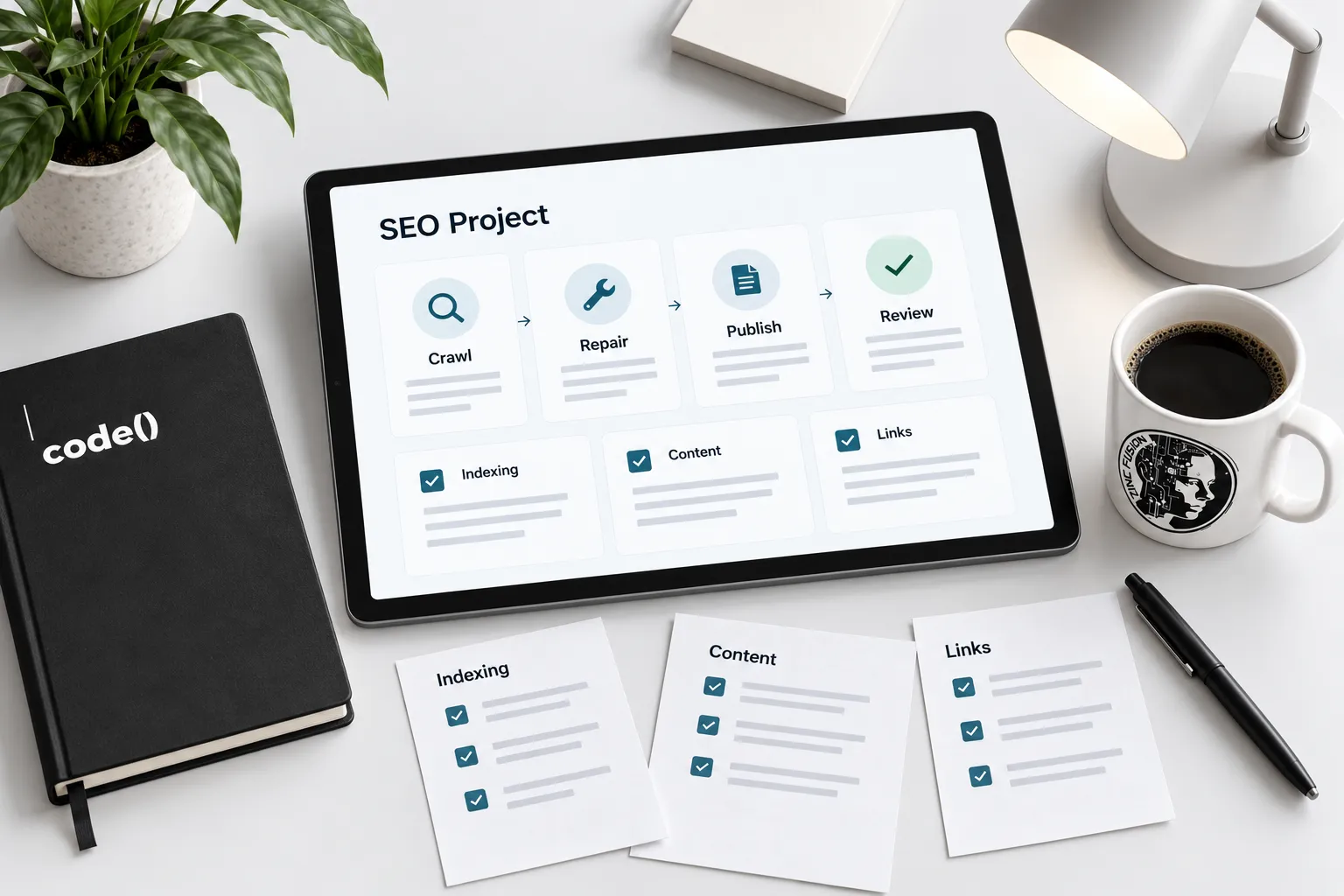
Implementation, crawling, indexing, ranking and customer response happen on different schedules. Agree on deliverables and leading checks first, then review outcomes over a suitable period. A fixed ranking deadline ignores both competition and the website’s starting point.
There is no reliable date on which SEO turns on. A technical correction, a new service page and a competitive market expansion have different dependencies.
You can still hold the work accountable. Agree on what will be delivered, what evidence should become available and when the next decision will be made. Keep those commitments separate from a promised ranking.
Separate the stages
| Stage | What you can verify | What it does not prove |
|---|---|---|
| Implementation | The agreed change is public and works | Google has processed it |
| Discovery | A crawler can reach the page through links or a sitemap | The page will be indexed |
| Indexing | The page appears in the indexed record | It will rank for the desired query |
| Search visibility | Relevant impressions and clicks appear | Those visitors are qualified customers |
| Business response | Valid inquiries or orders occur | SEO alone caused them |
Google's guide to how Search works explains crawling, indexing and serving as separate stages. Its indexing request guidance makes clear that requesting a crawl does not guarantee inclusion.
Set an initial delivery plan
In the first review period, expect a baseline, named priorities and evidence of completed work. If a service page is blocked or an inquiry form fails, the plan should identify an owner and acceptance test.
A reasonable plan may include business-fact verification, a sample of priority pages, technical corrections and a content brief. The exact sequence depends on the site. Do not replace a delivery plan with a vague instruction to wait six months.
Worked example: an audit is not a deployment
Imagine an audit identifies incorrect canonical tags in January. The developer receives approval in February and releases the correction in March. The relevant implementation date is March, not the date the audit was emailed.
Record the affected URLs and inspect the public tags after release. Then check Google's indexed evidence as it becomes available. If the declared canonical is corrected but Google selects another URL, investigate equivalence and other signals instead of treating the task as automatically finished.
Explain what is holding progress back
Useful questions include: Is the change awaiting approval? Is the page discoverable? Does it serve a distinct customer need? Is important evidence missing? Does the business have capacity to respond to inquiries? Are reporting definitions consistent?
A new business entering a competitive market may need substantial work and time to establish relevance and recognition. That is context for planning, not a reason to accept indefinite activity without evidence.
Use monthly reviews to make decisions
Bring completed changes, validation, relevant search observations, qualified inquiries and unresolved dependencies. Compare suitable periods and label low-volume uncertainty. Preserve original publication dates; changing a date without a substantive update does not create better content.
If a core update overlaps the review, follow Google's core update guidance and avoid assigning every movement to your latest change.
Our work has included national SEO and enterprise local search. Those are different scopes of work. A credible schedule starts with the actual pages, operational requirements and dependencies; the word “SEO” alone is not enough information to put a finish date on the job.
Agree on the next checkpoint
The next checkpoint should name the decision and required evidence: confirm indexability, assess a rewritten service page, or reconcile inquiry quality. It should not promise a position by an arbitrary date.
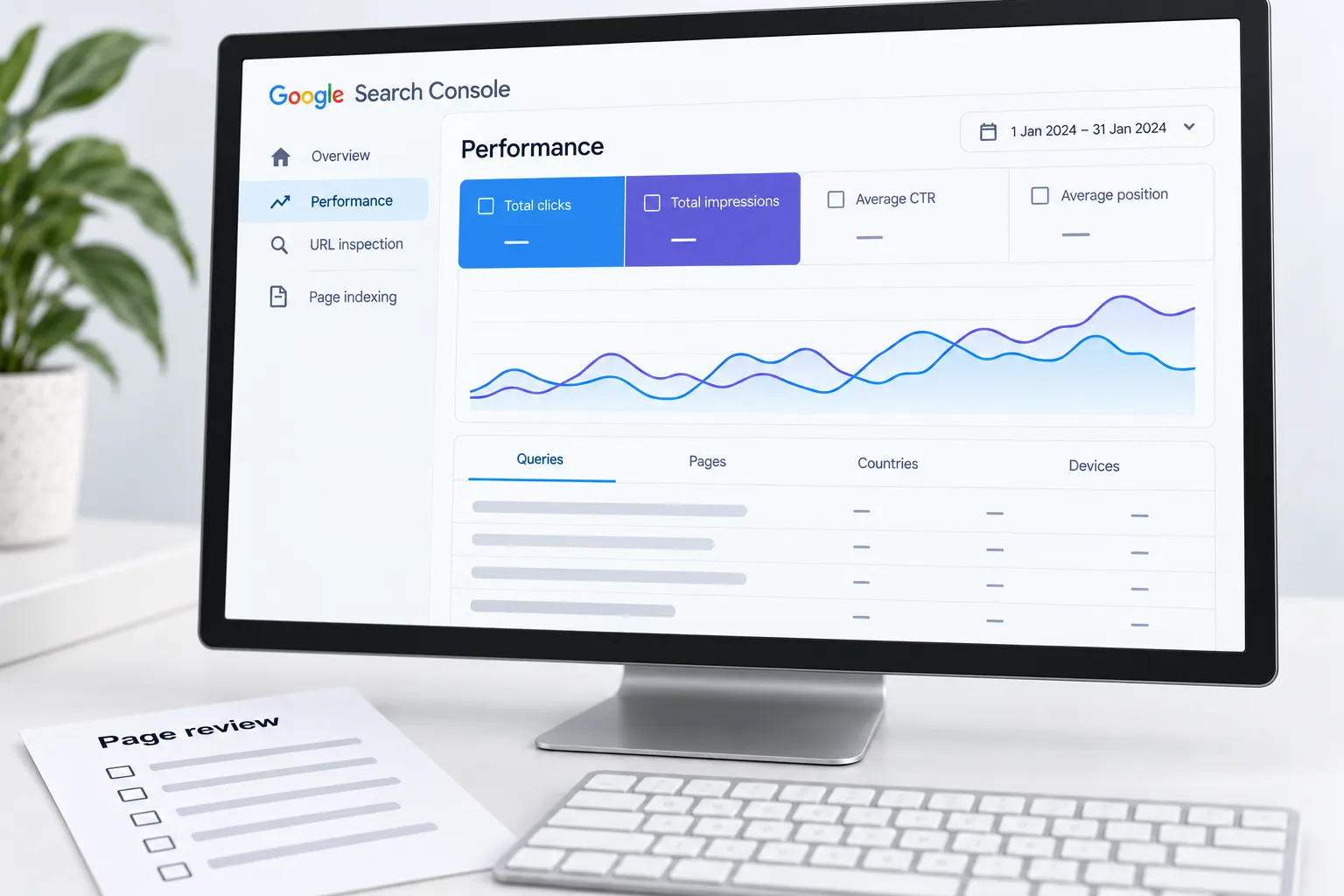
Use the Search Console guide and fillable review workbook to keep observations consistent. Good SEO reporting shows what happened, what remains uncertain and what happens next.
Ask an SEO provider to scope the next checkpoint in those terms: the change, the evidence to inspect and the decision it will inform. Keep a ranking deadline out of the acceptance criteria.
Sources
- guide to how Search worksdevelopers.google.com
- indexing request guidancedevelopers.google.com
- core update guidancedevelopers.google.com